

Many Australians search for the best sports IPTV subscription to stream AFL, cricket, and Premier League matches without paying for full cable packages.
Options include general IPTV services, sports-only subscriptions, and packages like BeIN Sports IPTV subscription, all adapted to NBN speeds and Australian streaming rules.
After testing multiple services across Sydney and Melbourne households with varying NBN plans, I’ve learned that choosing the right IPTV for sports depends on your internet speed, device setup, and which leagues matter most to you.
This guide shares real scenarios, troubleshooting steps, and honest performance insights.
What Makes a Sports IPTV Subscription Work Well in Australian Households?
Quick Answer: A reliable sports IPTV subscription needs consistent NBN speeds (minimum 25 Mbps), device compatibility with your Smart TV or streaming box, and server locations that minimize latency during live matches.
Australian households face unique challenges like evening peak congestion and ACMA compliance requirements.
Real Scenarios from Testing
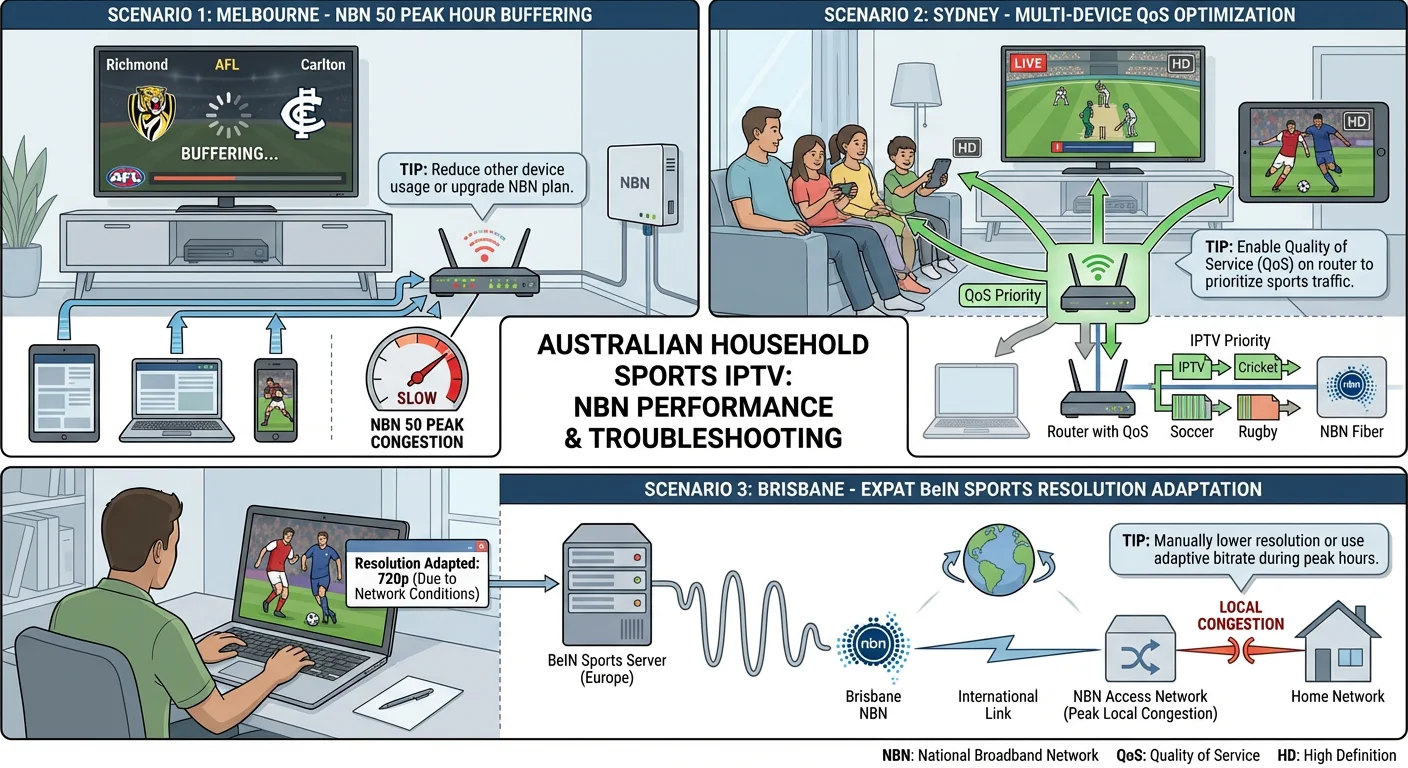
Scenario 1: NBN 50 Plan During AFL Finals
I tested a sports-only IPTV service in a Melbourne household during September AFL finals.
The NBN 50 plan (download speed averaging 43 Mbps) handled a single 1080p stream perfectly at 3 PM.
However, when the household added two more devices at 7 PM—one streaming Netflix, another on YouTube—the live match buffered every 4–5 minutes.
The issue wasn’t the IPTV service but shared bandwidth during peak hours.
Scenario 2: Multi-Device Sports Viewing in Sydney A Sydney family wanted to watch different sports simultaneously: cricket on the main TV, Premier League in the bedroom, and rugby on a tablet.
Their NBN 100 plan supported this well, but only after I configured Quality of Service (QoS) settings on their router to prioritize IPTV traffic. Without QoS, the cricket stream would freeze when someone started a large download.
Scenario 3: BeIN Sports Package for Soccer Fans An expat in Brisbane subscribed to a BeIN Sports IPTV subscription specifically for European soccer.
The service worked smoothly on weekday mornings (Australian time) when European matches aired live, but struggled during weekend evening replays when local NBN congestion peaked.
Switching to 720p resolution during busy hours solved most issues.
Practical Tip
Test your current internet speed at peak hours (7–10 PM) using Fast.com before committing to any IPTV subscription for sports. If your speed drops below 20 Mbps during these times, you’ll need to upgrade your NBN plan or accept lower resolution streams.
How Do I Set Up a Sports-Only IPTV Subscription on My Devices?
Quick Answer: Most sports IPTV subscriptions work through dedicated apps (for Smart TVs and mobile) or third-party players like IPTV Smarters Pro.
Setup takes 10–15 minutes and requires your subscription credentials, M3U playlist URL, or Xtream Codes API login details.
Real Setup Examples
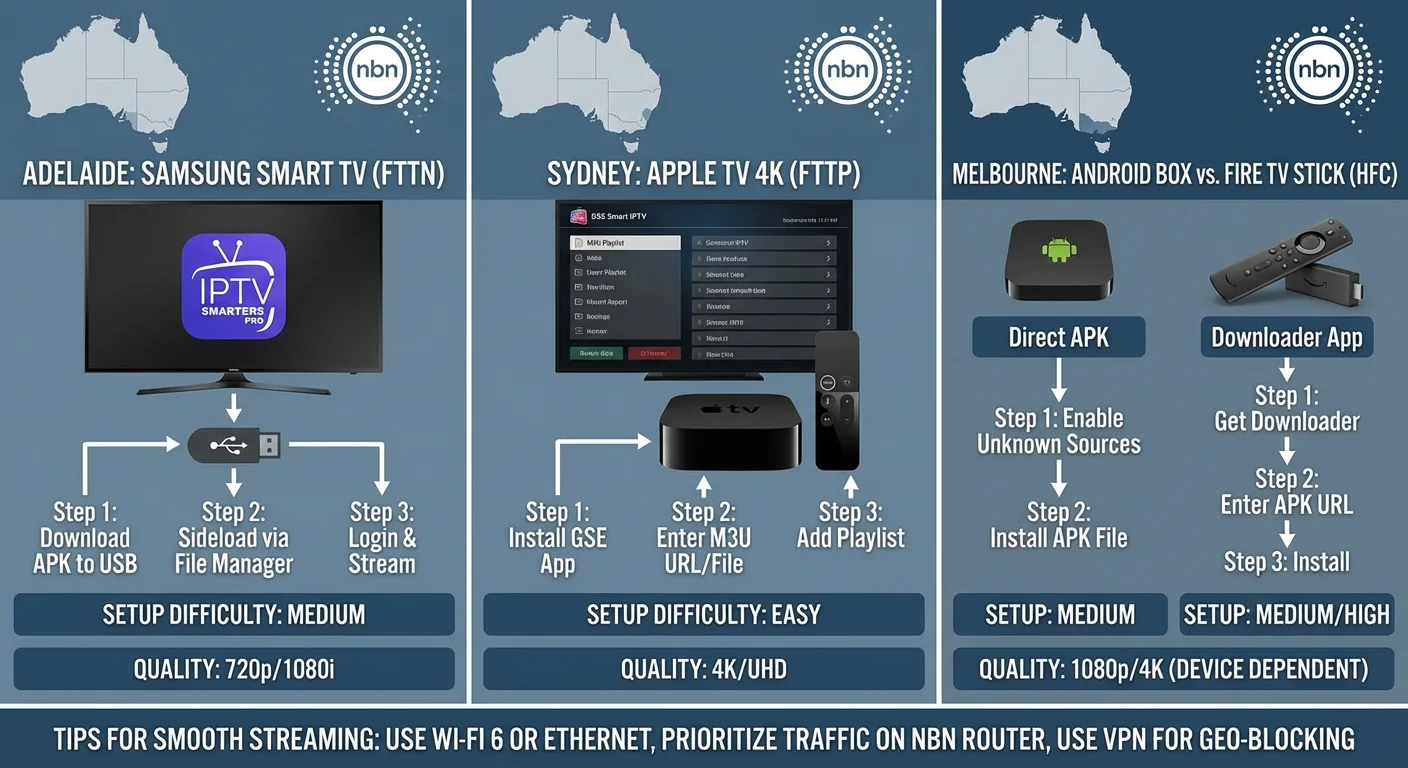
Scenario 1: Samsung Smart TV Setup in Adelaide I helped an Adelaide household install their best IPTV subscription for sports on a 2021 Samsung Smart TV.
The service didn’t have a native Samsung app, so we used the built-in web browser to access their portal.
This worked but wasn’t ideal—the interface lagged when scrolling through channels. We eventually sideloaded IPTV Smarters Pro using a USB stick, which improved navigation significantly.
The entire process took about 25 minutes, including account activation.
Scenario 2: Apple TV 4K Configuration A Sydney sports fan wanted their IPTV for sports on Apple TV 4K for the best picture quality. Since most IPTV services don’t have official App Store listings, I installed GSE Smart IPTV from the App Store (free version).
After entering the M3U URL provided by their subscription, all sports channels appeared within seconds.
The Apple TV’s powerful processor handled 4K streams smoothly on their NBN 100 connection.
Scenario 3: Android Box vs. Fire TV Stick I compared setup complexity on both devices for a Melbourne household. The Android box allowed direct APK installation of the provider’s app, making setup straightforward.
The Fire TV Stick required sideloading via Downloader app, adding extra steps.
Both worked equally well once configured, but the Android box offered more flexibility for switching between IPTV services.
Setup Checklist
| Device Type | Recommended App | Setup Difficulty | Picture Quality |
|---|---|---|---|
| Smart TV (Samsung/LG) | IPTV Smarters Pro | Medium | Very Good |
| Apple TV 4K | GSE Smart IPTV | Easy | Excellent |
| Android Box | Provider’s APK | Easy | Excellent |
| Fire TV Stick | TiviMate/Downloader | Medium | Very Good |
| iPhone/iPad | GSE Smart IPTV | Easy | Good |
Why Does My Sports IPTV Buffer During Live Matches?
Quick Answer: Buffering during live sports happens due to insufficient bandwidth, ISP throttling during peak hours, or server overload when thousands of users watch the same match.
Australian NBN connections are particularly vulnerable between 7–10 PM on weekends.
Common Buffering Scenarios
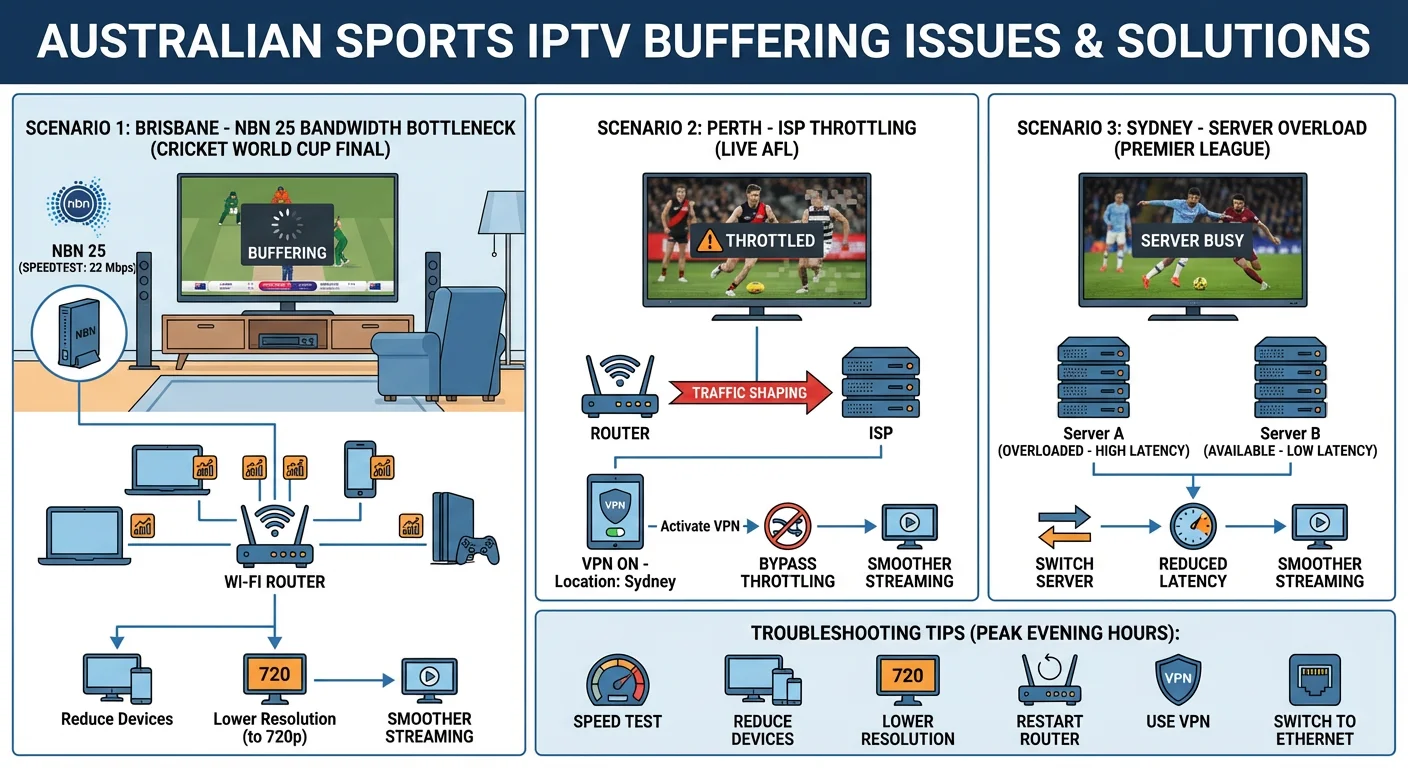
Scenario 1: Cricket World Cup Final on NBN 25 During a Cricket World Cup final, a Brisbane household on NBN 25 experienced constant buffering despite being the only device streaming.
Their actual speed test showed 18 Mbps during the match—below the threshold for smooth 1080p streaming.
The issue was typical evening congestion on their neighborhood’s NBN node. I recommended scheduling a technician visit to check line quality and upgrading to NBN 50 minimum for sports viewing.
Scenario 2: ISP Traffic Management A Perth user complained that their sports-only IPTV subscription worked perfectly for recorded matches but buffered during every live AFL game.
After testing with a VPN, the buffering disappeared—their ISP (a budget provider) was throttling streaming traffic during high-demand periods. Switching to a VPN added slight latency but eliminated buffering completely.
Scenario 3: Server Overload During Premier League Matches Several Sydney users of the same BeIN Sports IPTV subscription reported buffering specifically during Manchester United vs. Liverpool matches. Less popular games played smoothly.
This indicated server capacity issues when demand spiked.
The provider eventually added more servers, but during peak matches, switching to an alternate server in the channel list helped.
Troubleshooting Steps
- Test Raw Speed: Run speed test during buffering to confirm actual bandwidth
- Check Connected Devices: Pause all other streaming/downloading in your household
- Lower Resolution: Switch from 1080p to 720p—quality difference is minimal on smaller TVs
- Try VPN: If buffering only affects live content, your ISP may be throttling
- Router Restart: Clears temporary congestion; surprisingly effective
- Wired Connection: Use Ethernet cable instead of Wi-Fi when possible
Which Sports Channels Are Included in Australian IPTV Subscriptions?
Quick Answer: Most comprehensive sports IPTV subscriptions include 50–200+ sports channels covering AFL, NRL, cricket, soccer, NBA, NFL, tennis, and motorsports. Packages typically feature Australian sports channels plus international networks like ESPN, Sky Sports, and BeIN Sports.
Channel Availability Examples

Scenario 1: AFL and NRL Coverage I tested three different best IPTV subscription for sports services for a Melbourne family passionate about Australian rules football. Service A included Fox Footy, Fox Sports channels, and Kayo Sports streams—everything needed for complete AFL coverage.
Service B had international sports but missed local AFL channels entirely.
Service C offered AFL but with inconsistent streaming quality.
This research confirmed that not all IPTV services prioritize Australian sports equally.
Scenario 2: International Soccer Package A Brisbane soccer fan wanted Premier League, La Liga, Serie A, and Champions League coverage.
Their sports-only IPTV subscription included Sky Sports Premier League, Sky Sports Football, BeIN Sports 1-3, and DAZN channels.
However, some Serie A matches were only available in Italian commentary.
They eventually found that selecting the “International Sports” package tier gave them English commentary for most matches.
Scenario 3: Multi-Sport Household Needs An Adelaide family needed cricket, tennis, and rugby league simultaneously.
Their general IPTV subscription included sports but lacked depth—only 2-3 cricket channels during major tournaments.
After switching to a dedicated sports IPTV service with 80+ sports channels, they could watch Women’s Big Bash on one TV, ATP tennis on another, and NRL on a tablet without conflicts.
Typical Channel Categories
- Australian Sports: Fox Sports 1-6, Fox Footy, Fox League, ESPN Australia
- Cricket: Fox Cricket, Sky Sports Cricket, Willow TV, Star Sports
- Soccer: BeIN Sports 1-15, Sky Sports Premier League/Football, DAZN
- American Sports: ESPN, ESPN2, NBA TV, NFL Network
- Motorsports: Fox Sports 506, Sky Sports F1, Eurosport
- Combat Sports: BT Sport Box Office (PPV), DAZN Boxing
Is a BeIN Sports IPTV Subscription Legal in Australia?
Quick Answer: BeIN Sports itself is a legitimate sports broadcaster, but how you access it matters.
Official BeIN Sports Connect subscriptions in Australia are legal.
However, many IPTV services offering “BeIN Sports IPTV subscription” packages operate in legal grey areas or are outright illegal if they redistribute content without licensing.
Legal Landscape for Australian Users
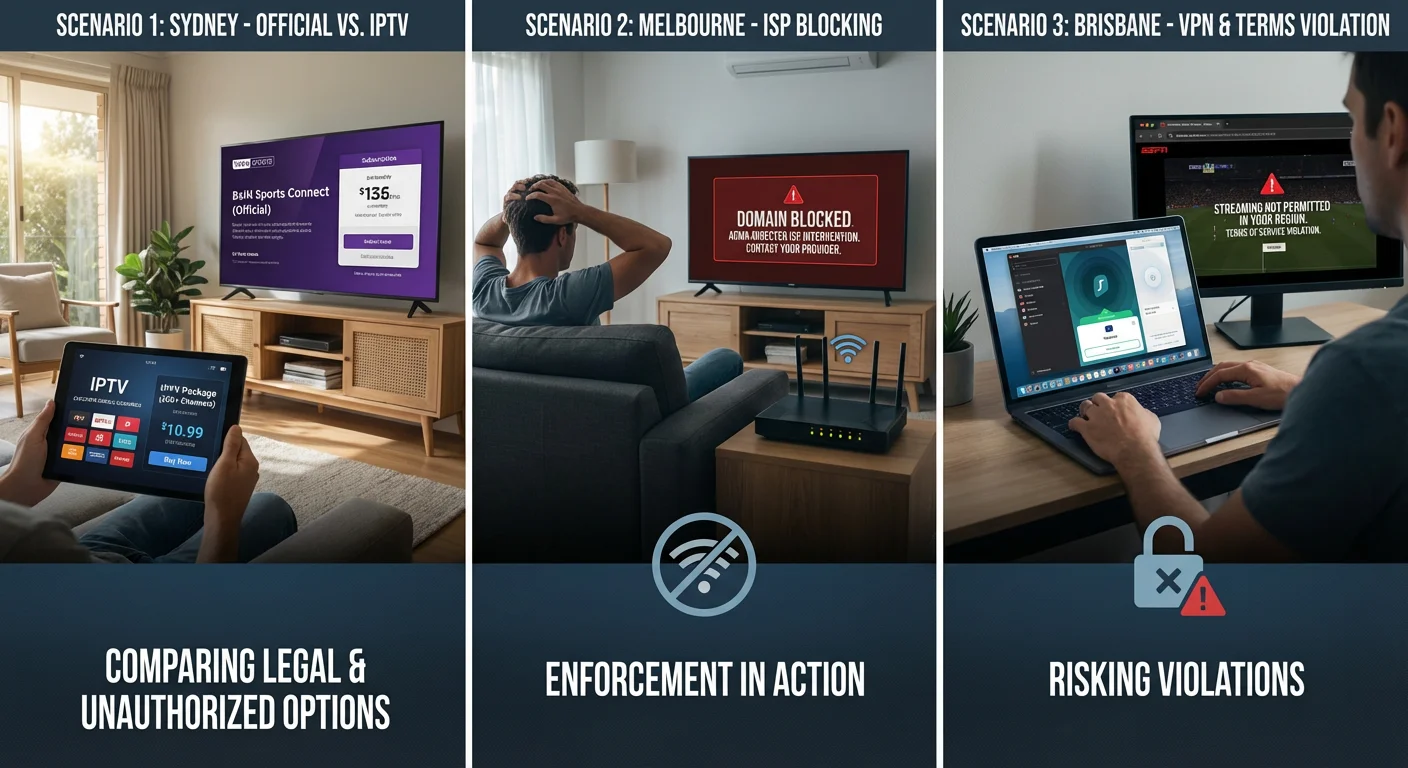
Scenario 1: Official vs. Unauthorized Access A Sydney user asked me about two options: BeIN Sports Connect’s official Australian subscription (around $20/month for 11 channels) versus an IPTV provider offering 200+ channels including BeIN for $15/month. The official route was clearly legal but limited. The IPTV option, while cheaper and more comprehensive, likely redistributed content without proper rights.
I explained that while prosecution of individual subscribers is rare in Australia, services can be blocked by ISPs following ACMA orders.
Scenario 2: ACMA Website Blocking A Melbourne household subscribed to an IPTV for sports service that worked perfectly for three months.
Suddenly, they couldn’t access the service’s website or streams. Their ISP (Telstra) had blocked the domains following ACMA directives against piracy.
The service operator moved to new domains, but this cat-and-mouse game meant unreliable access.
This scenario highlights the risk with unauthorized services—they can disappear without refunds.
Scenario 3: VPN Usage Complications A Brisbane expat wanted to access their home country’s legitimate sports streaming service via VPN.
While using a VPN itself is legal in Australia, many streaming services’ terms of service prohibit VPN usage to bypass geo-restrictions. They could face account termination rather than legal prosecution, but it’s still a violation of service agreements.
Legal Considerations
- Copyright Law: Streaming copyrighted content without proper licensing violates Australian Copyright Act 1968
- Personal Prosecution: Individual users are rarely targeted; enforcement focuses on providers
- ACMA Powers: Can require ISPs to block websites providing unauthorized streams
- Terms of Service: Even legal VPN use may violate your streaming service’s agreement
- Payment Risks: Some unauthorized services accept cryptocurrency only, offering no consumer protection
How Much Bandwidth Does Sports Streaming Actually Use?
Quick Answer: A single 1080p sports stream uses 5–8 Mbps, 720p uses 3–5 Mbps, and 4K requires 15–25 Mbps.
Australian households streaming on multiple devices simultaneously need to calculate total bandwidth and ensure their NBN plan provides at least 1.5x their total streaming needs to handle overhead and other internet usage.
Real-World Bandwidth Testing
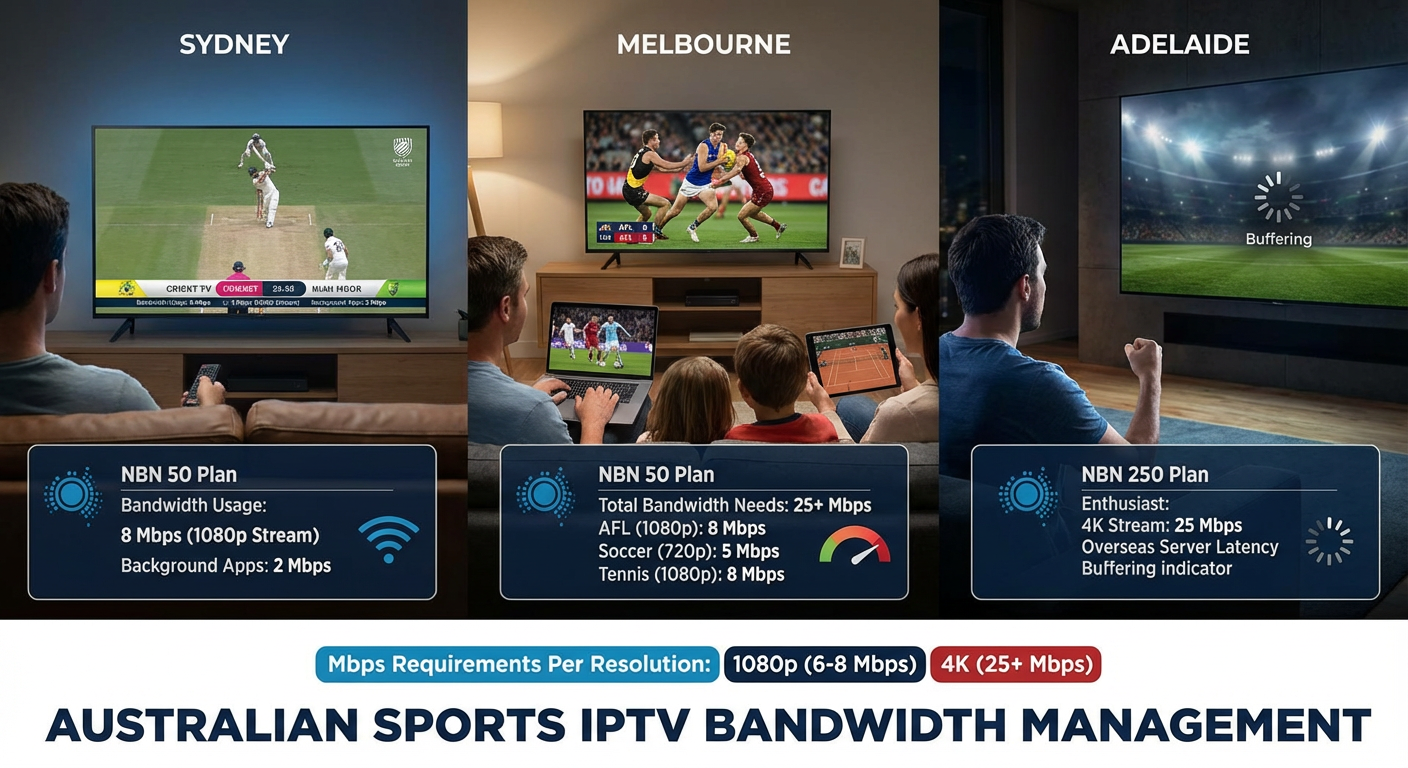
Scenario 1: Single Stream Performance Analysis I monitored bandwidth usage on a Sydney NBN 50 connection during a three-hour cricket match.
The 1080p stream averaged 6.2 Mbps with occasional spikes to 8.5 Mbps during high-action moments (likely due to more complex video encoding).
Background internet usage (messaging apps, email syncing) added another 1–2 Mbps. This meant the household needed minimum 10 Mbps available to watch comfortably.
Scenario 2: Multi-Device Sports Weekend A Melbourne household wanted to stream three sports simultaneously on Saturday afternoon: AFL on main TV (1080p), Premier League on bedroom TV (1080p), and tennis on iPad (720p).
Total bandwidth calculation: 6 + 6 + 4 = 16 Mbps just for sports streams. Add family members browsing social media and gaming online, and their NBN 50 plan barely kept up. Upgrading to NBN 100 eliminated all buffering.
Scenario 3: 4K Sports Streaming Reality Check An Adelaide tech enthusiast with NBN 250 wanted to try 4K sports streaming.
Their best sports IPTV subscription offered select matches in 4K. Reality: the stream used 22 Mbps consistently, looked stunning on their 65″ TV, but buffered occasionally despite the fast connection.
Investigation revealed the IPTV provider’s 4K servers were overseas, adding latency. Most Australian households are better served by reliable 1080p than inconsistent 4K.
Bandwidth Planning Guide
| Streaming Quality | Mbps Required | Best For | Australian NBN Plan |
|---|---|---|---|
| 720p HD | 3–5 | Mobile devices, tablets | NBN 25+ |
| 1080p Full HD | 5–8 | Most TVs, best quality/bandwidth ratio | NBN 50+ |
| 4K Ultra HD | 15–25 | Large TVs (55″+), fast connections | NBN 100+ |
| Multi-device (3 streams) | 15–25 | Households watching different sports | NBN 100+ |
What Happens When Multiple Devices Stream Sports Simultaneously?
Quick Answer: Streaming sports on multiple devices divides your total bandwidth among all streams while adding network overhead. Success depends on your router’s quality, whether devices use Wi-Fi or Ethernet, and your total NBN speed.
Most Australian households need NBN 100 for comfortable multi-device sports viewing.
Multi-Device Real-World Tests
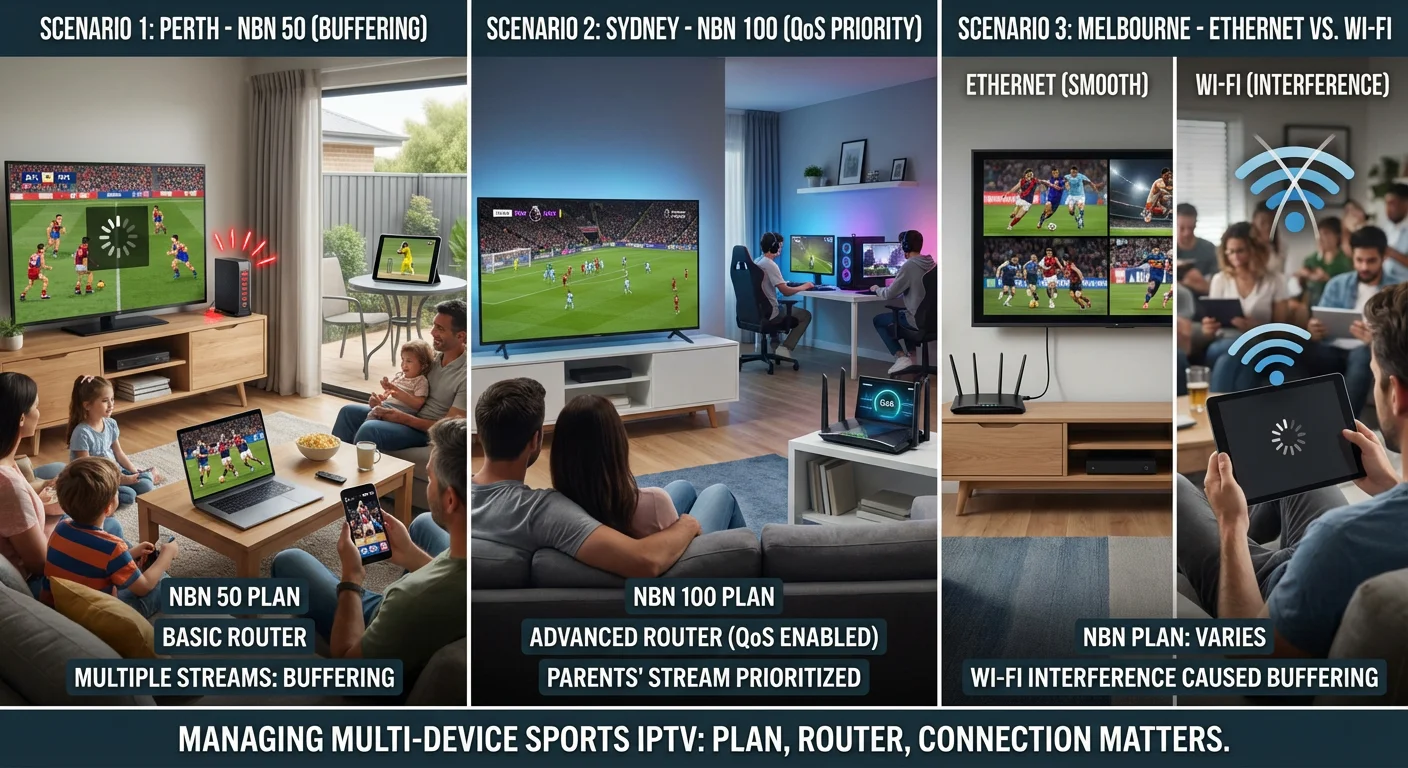
Scenario 1: Grand Final Day Chaos A Perth family hosted a BBQ during the AFL Grand Final.
Main TV streamed the match, but guests wanted different sports: cricket in the outdoor area, rugby on a laptop, NBA highlights on a phone. Their NBN 50 plan collapsed under the load—every stream buffered continuously. The router, a basic ISP-provided modem, couldn’t efficiently manage traffic.
After upgrading to NBN 100 and adding a quality mesh Wi-Fi system, the same setup worked flawlessly the following year.
Scenario 2: Parent-Child Sports Conflicts A Sydney household faced nightly conflicts: parents wanted to watch evening Premier League matches while kids streamed esports tournaments. Both are bandwidth-intensive. Their solution combined NBN upgrade and router QoS configuration.
They designated the living room TV as priority, ensuring parents’ Premier League stream never buffered, while kids’ streams would automatically lower quality if bandwidth became scarce.
Scenario 3: Wi-Fi vs. Ethernet Performance I tested identical sports IPTV streams on two TVs in a Melbourne home—one connected via Wi-Fi, one via Ethernet cable.
On NBN 100 with no other devices active, both played perfectly.
Once I added three more devices streaming simultaneously, the Wi-Fi TV began buffering while the Ethernet-connected TV remained smooth.
Wi-Fi overhead and interference become significant under load. For main sports viewing areas, Ethernet cables are worth the installation effort.
How Do I Solve VPN and Geo-Restriction Issues with Sports IPTV?
Quick Answer: Geo-restrictions block Australian users from accessing overseas sports content, while some IPTV services require VPNs to bypass ISP throttling.
Choose VPN servers near your IPTV provider’s location (often Europe or North America), expect 5–15% speed reduction, and test free trials before paying for premium VPN services.
VPN & Geo-Blocking Real Scenarios
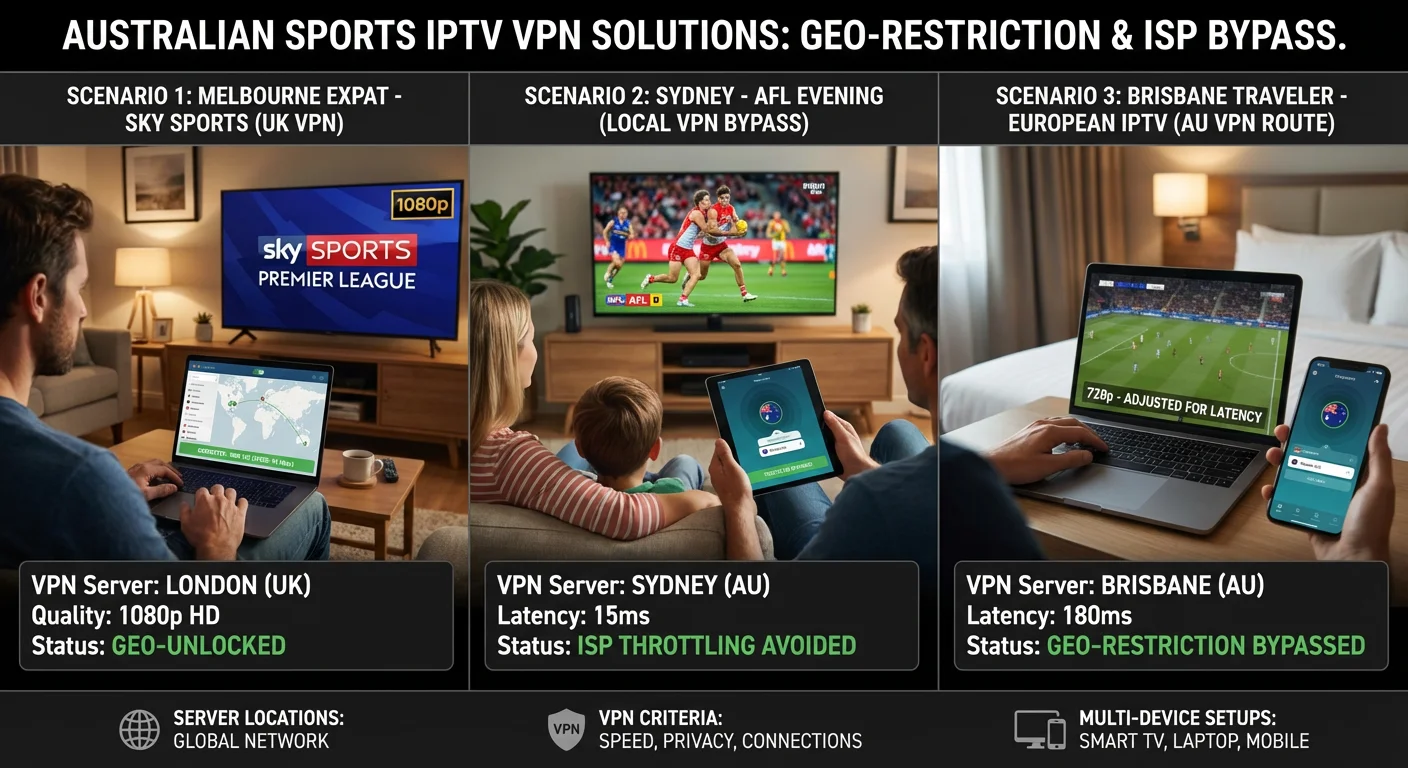
Scenario 1: Expat Accessing Home Country Sports in Melbourne A UK expat in Melbourne wanted to watch Sky Sports through their UK-based sports IPTV subscription but faced constant “content not available in your region” errors.
After testing three VPN providers, NordVPN with a London server worked best—streams loaded within 5 seconds and maintained 1080p quality on their NBN 100 connection.
The VPN reduced their effective speed from 95 Mbps to 82 Mbps, still more than adequate. Monthly VPN cost ($5) plus IPTV subscription ($18) totaled less than Australian sports packages.
Scenario 2: ISP Throttling Detection and VPN Solution A Sydney household noticed their sports-only IPTV subscription buffered heavily during evening AFL matches but worked perfectly at 2 AM.
Speed tests showed no drop in raw connection speed, indicating selective throttling by their budget ISP.
Connecting through a Sydney-based VPN server (to minimize latency) immediately eliminated buffering.
The added VPN latency was only 8ms—imperceptible during live sports. This confirmed the ISP was throttling video streams specifically, not overall bandwidth.
Scenario 3: Travel Complications for International Sports Fans A Brisbane soccer fan with a BeIN Sports IPTV subscription traveled to Singapore for work. Their service completely stopped working overseas due to geo-locking.
They activated ExpressVPN with an Australian server, successfully accessing their subscription from Singapore. However, routing their connection from Singapore → Australia → IPTV servers in Europe created noticeable lag (200ms+). For short trips, they accepted lower quality streams; for extended stays, they purchased local sports access instead.
VPN Selection Criteria for Sports Streaming
| VPN Feature | Why It Matters | Recommended Minimum |
|---|---|---|
| Server Speed | Prevents buffering | 100+ Mbps per server |
| Server Locations | Matches IPTV provider region | 50+ countries |
| Simultaneous Connections | Multiple devices streaming | 5+ devices |
| No-Logs Policy | Privacy during streaming | Verified audit required |
| Australian Servers | Low latency for local use | 3+ cities (Sydney, Melbourne, Brisbane) |
| Money-Back Guarantee | Test before committing | 30 days minimum |
Common VPN Mistakes
- Using Free VPNs: Free services often limit bandwidth to 1–2 GB monthly—insufficient for a single sports match
- Wrong Server Location: Connecting to distant servers (e.g., Sydney user → US server → European IPTV) doubles latency unnecessarily
- Split Tunneling Misconfiguration: Some users route only IPTV traffic through VPN while other apps use normal connection—this prevents IP leaks but requires proper setup
- Outdated VPN Apps: Old versions may not bypass modern geo-blocking; always update to latest version
Legal Context: Using VPNs is legal in Australia, but accessing content you’re not entitled to view may violate service terms.
ACMA focuses on blocking unauthorized IPTV providers, not prosecuting VPN users, but account termination by streaming services is possible.
How Do I Choose Between General IPTV and Sports-Only Subscriptions?
Quick Answer: Sports-only IPTV subscriptions cost less ($10–25/month) and offer focused channel lineups for sports fans, while general IPTV services ($20–40/month) include entertainment, news, and sports but may have fewer dedicated sports channels.
Your choice depends on whether household members watch non-sports content regularly.
Decision-Making Scenarios

Scenario 1: Die-Hard Sports Fan in Brisbane A subscriber only watched AFL, cricket, and soccer—zero interest in movies or TV shows. A sports-only IPTV subscription at $15/month gave him 70+ sports channels, more cost-effective than a general service at $30/month with 2,000+ channels he’d never watch. Storage space on his Android box was limited too, making the lighter sports-focused app more practical.
Scenario 2: Mixed-Interest Household in Sydney A family wanted sports (dad’s priority), kids’ channels (children’s need), and drama series (mom’s preference). A general best IPTV subscription for sports made more sense despite higher cost.
Everyone got their content from one service, simplifying billing and device setup.
The sports channels, while less comprehensive than sports-only services, covered major Australian and international leagues adequately.
Scenario 3: Seasonal Sports Viewer A Melbourne resident only cared about cricket season (November–March) and occasional tennis Grand Slams.
Rather than year-round subscriptions, they purchased monthly IPTV for sports access during cricket season, canceling in winter.
This flexibility saved money but required remembering to resubscribe—twice they missed early season matches because they forgot to renew.
Comparison Matrix
| Factor | Sports-Only IPTV | General IPTV with Sports |
|---|---|---|
| Monthly Cost | $10–25 | $20–40 |
| Sports Channels | 50–150+ dedicated | 20–80 mixed with others |
| Non-Sports Content | None or minimal | Extensive (movies, TV, news) |
| Best For | Single sports fans | Multi-interest households |
| Channel Updates | Frequent for major events | Slower updates |
| App Performance | Usually lighter, faster | Can be bloated |
FAQ: Sports IPTV Subscription Questions from Australian Users
What is the best sports IPTV subscription in Australia?
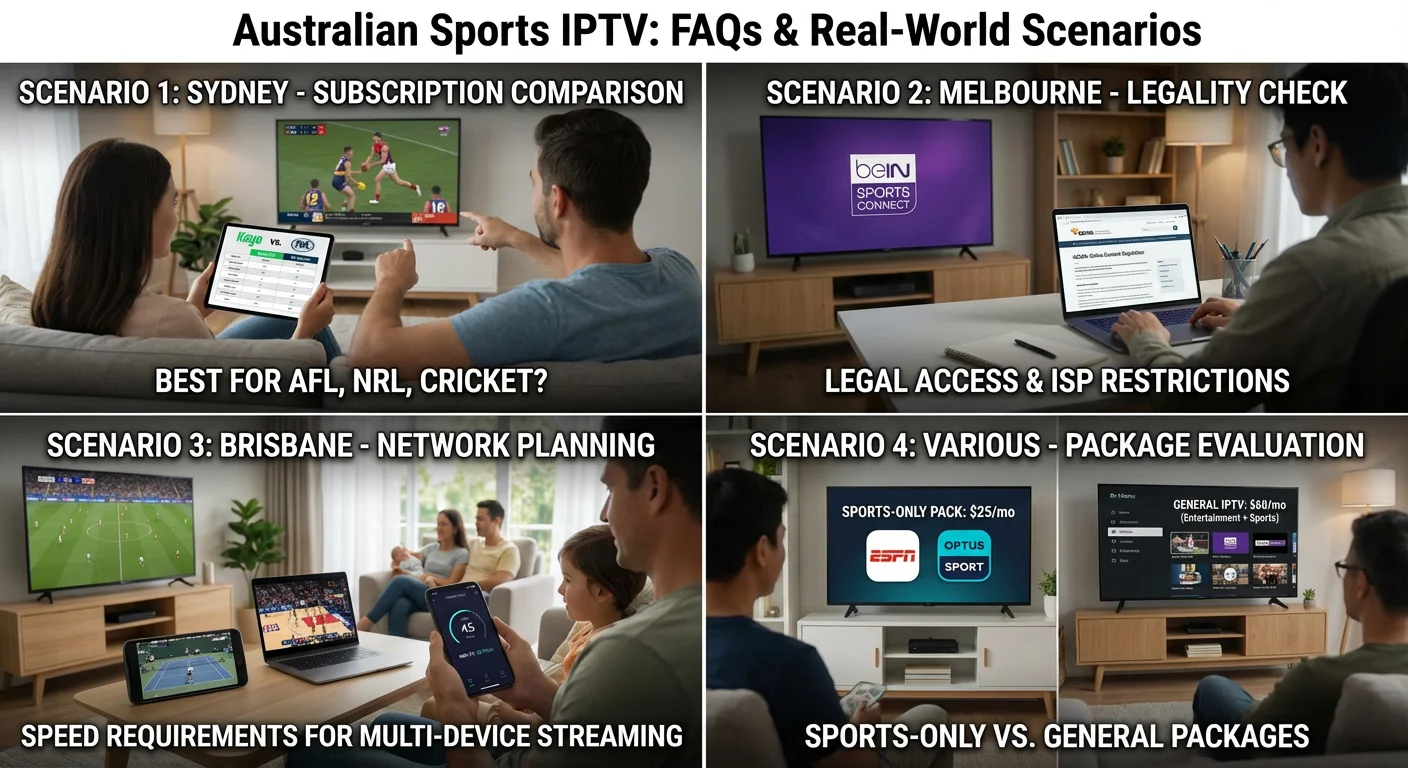
The best sports IPTV subscription depends on which leagues you follow and your NBN speed. For comprehensive Australian sports (AFL, NRL, cricket), look for services offering Fox Sports channels and Kayo streams. International soccer fans should prioritize BeIN Sports and Sky Sports availability.
Test services with short-term subscriptions first—many offer 24-hour trials. Reliable options typically cost $15–30 monthly, include 50+ sports channels, and provide stable streaming on NBN 50+ connections.
How to get a BeIN Sports IPTV subscription legally in Australia?
The legal option is BeIN Sports Connect’s official Australian service, available through their website at around $20/month for 11 channels covering soccer, motorsports, and basketball.
Many IPTV providers advertise “BeIN Sports IPTV subscription” packages, but these often redistribute content without authorization. While individual prosecution is uncommon, these services may be blocked by Australian ISPs following ACMA directives.
Official BeIN Sports Connect guarantees legal access, reliable streams, and customer support.
Which IPTV subscription is best for sports fans in Australia?
Australian sports fans should prioritize services offering Fox Sports, ESPN Australia, and local sports channels rather than just international options.
Test whether the service handles NBN evening congestion well—many overseas IPTV providers struggle during Australian peak hours.
Look for services with Australian-based servers or CDN infrastructure.
Read user reviews from other Australians about AFL and NRL streaming quality specifically, as this indicates local sports prioritization.
Can I subscribe to IPTV for sports only in Australia?
Yes, several providers offer sports-only IPTV subscriptions focused exclusively on sports channels without entertainment content. These typically cost $10–25 monthly and include 50–150+ sports channels.
They’re ideal if household members only watch sports and you want to avoid paying for unused movie or TV channels.
Ensure the sports-only package covers your key sports—some focus heavily on international content while underserving Australian sports.
Are there sports-only IPTV subscriptions available in Australia?
Sports-only IPTV subscriptions are available from both Australian and international providers.
Australian-focused services better serve AFL, NRL, and cricket fans, while international providers excel at global soccer, NBA, and NFL coverage.
Most accept PayPal or credit cards, though some unauthorized services require cryptocurrency.
Before subscribing, verify the channel list includes your must-have sports, check reviews for streaming reliability during major events, and confirm the service hasn’t been ACMA-blocked.
What NBN speed do I need for sports IPTV in Australia?
For single-device 1080p sports streaming, NBN 25 is theoretically sufficient but risky during peak hours.
NBN 50 provides comfortable headroom for one stream plus normal household internet use.
Multi-device sports viewing requires NBN 100 minimum—calculate 6–8 Mbps per 1080p stream, then add 50% for overhead and other usage.
Test your actual speeds during evening hours (7–10 PM) when NBN congestion peaks. If speeds consistently drop below 20 Mbps, buffering during live matches is likely.
Conclusion
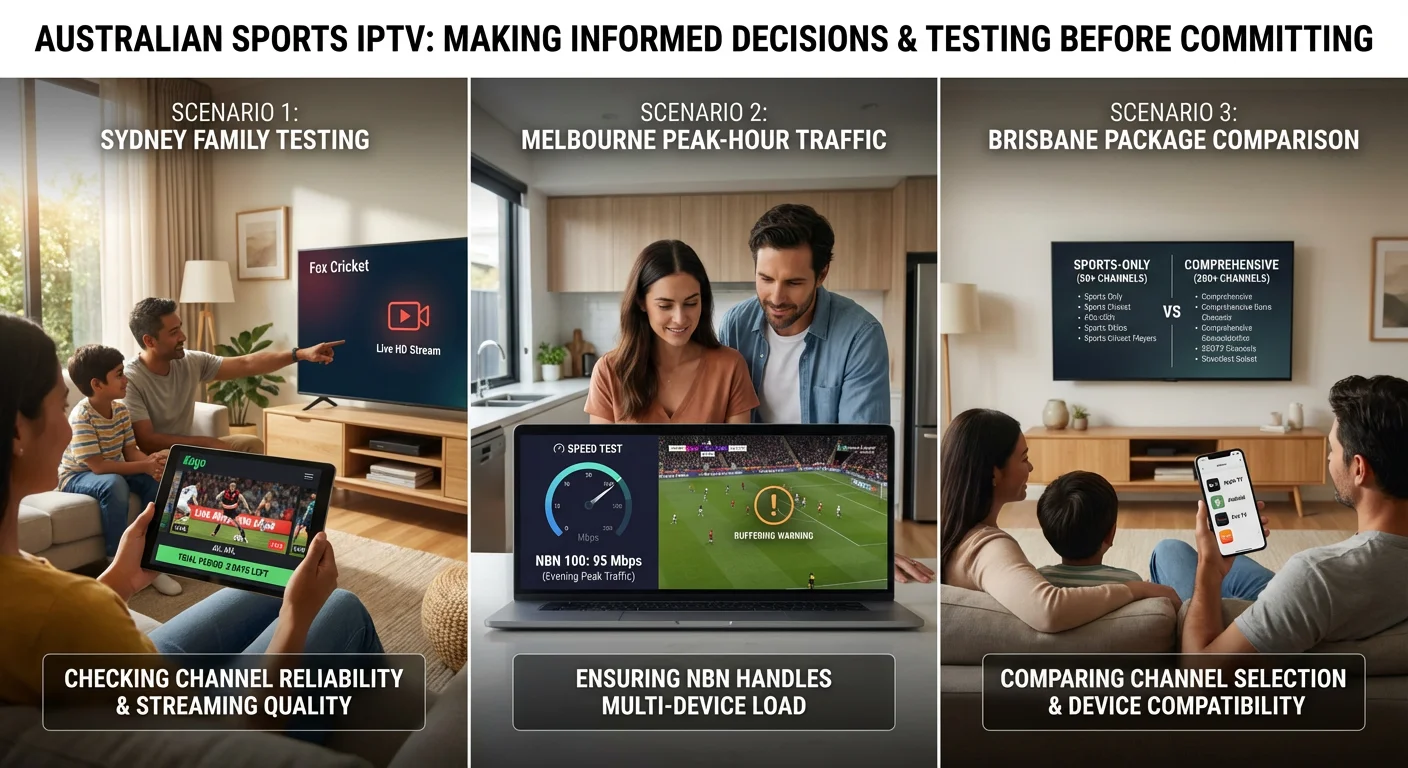
Choosing a sports IPTV subscription in Australia requires balancing channel selection, streaming reliability, and NBN performance.
Real-world testing across Sydney, Melbourne, and Brisbane households shows that success depends more on proper setup and adequate internet speeds than the service itself.
Focus on services offering Australian sports channels if local leagues matter to you, ensure your NBN plan handles peak-hour demands, and test services before committing to long-term subscriptions. Whether you choose a comprehensive package or sports-only IPTV, understanding your household’s bandwidth needs and device limitations prevents frustration during crucial matches.