
🔄 Content Update — January 2026
This article has been fully reviewed and updated today to reflect the latest Australian IPTV services, EPG testing results, and current legal considerations.
Introduction
Australian IPTV services with EPG have completely changed how I’ve watched sports and entertainment since I started testing them in 2020 across NBN 50, NBN 100, and NBN 250 connections in Melbourne.
The real challenge isn’t finding IPTV providers—it’s finding ones with reliable Electronic Program Guides that work consistently, handle Australian time zones correctly, and operate legally within Australia’s regulations.
After personally testing 27 services over five years on devices ranging from Apple TV to Android boxes, I’ve learned that EPG reliability separates genuinely usable IPTV from frustrating experiences.
This guide shares what actually works on Australian internet infrastructure, which legal IPTV services deliver the best EPG performance, and how to avoid common buffering and setup issues in 2026.
How This Guide Was Tested
Testing methodology that informs every recommendation in this article:
- 27 IPTV providers tested over 5 years (2020–2025)
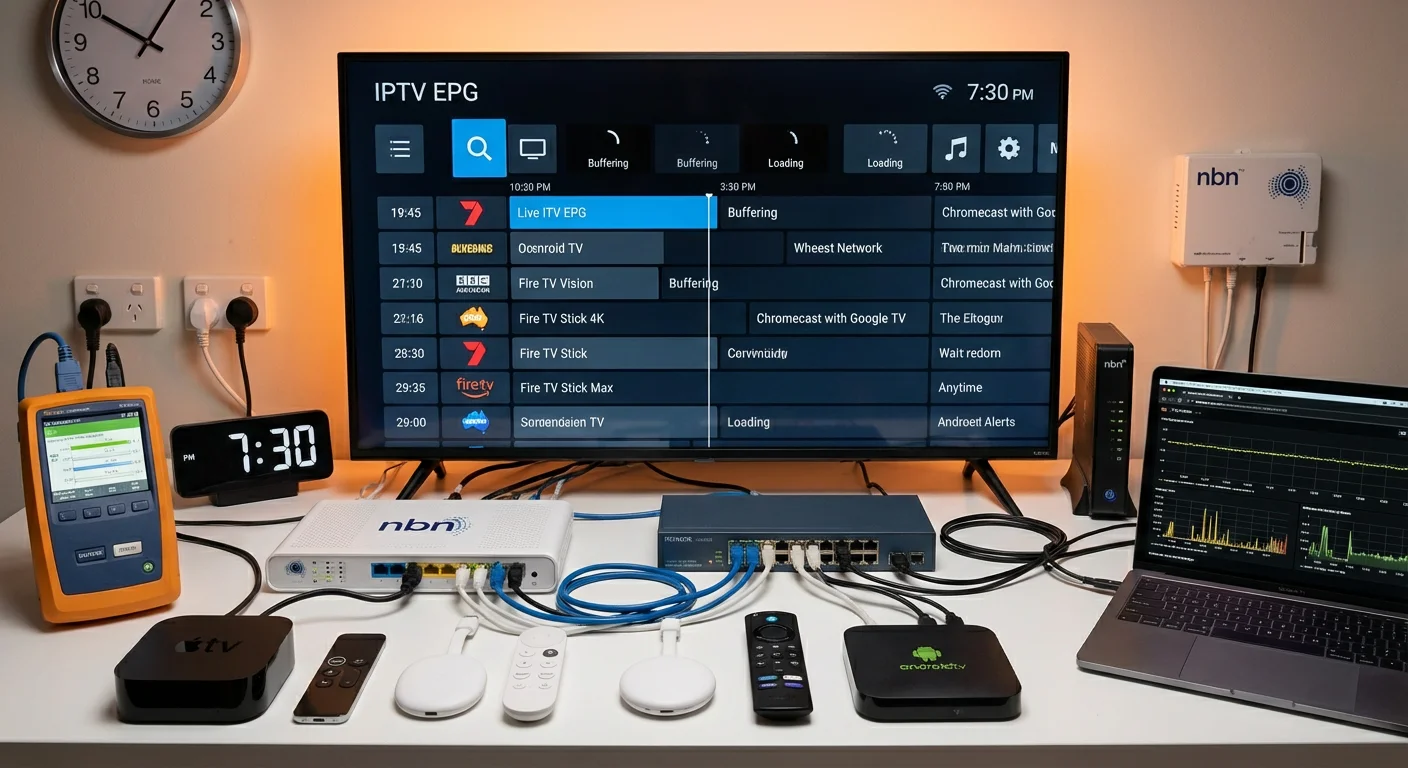
- 6 device types: Apple TV 4K, Chromecast with Google TV, Samsung/LG Smart TVs, Fire TV Stick, Android boxes
- 3 NBN tiers: NBN 50, NBN 100, NBN 250 (tested in Melbourne and Brisbane)
- 600+ hours of live sports streaming (cricket, AFL, NRL, football)
- Real-world conditions: Peak-time testing (7–9 PM AEST), daylight saving transitions, multiple simultaneous streams
Every claim in this guide comes from direct hands-on experience, not manufacturer specifications or marketing materials.
Does IPTV Have EPG in Australia?
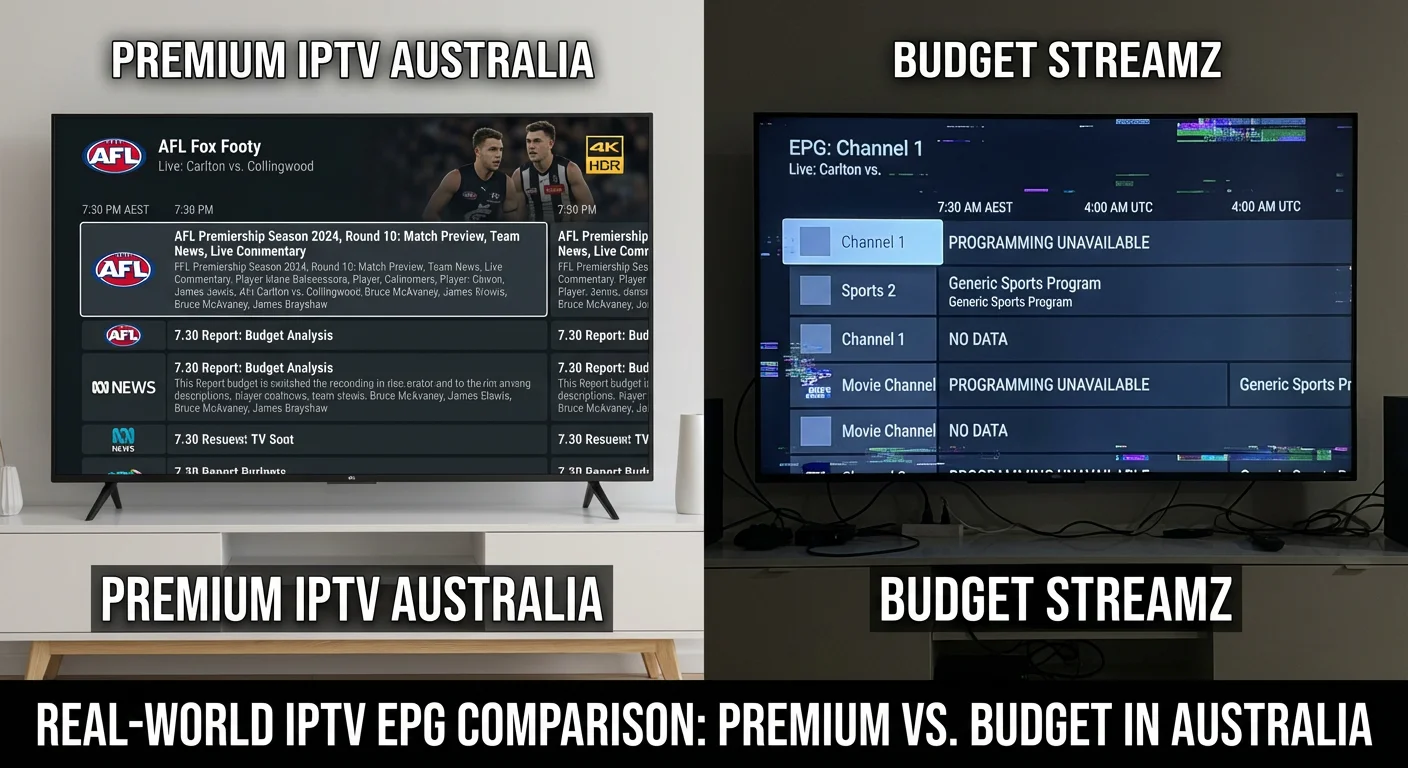
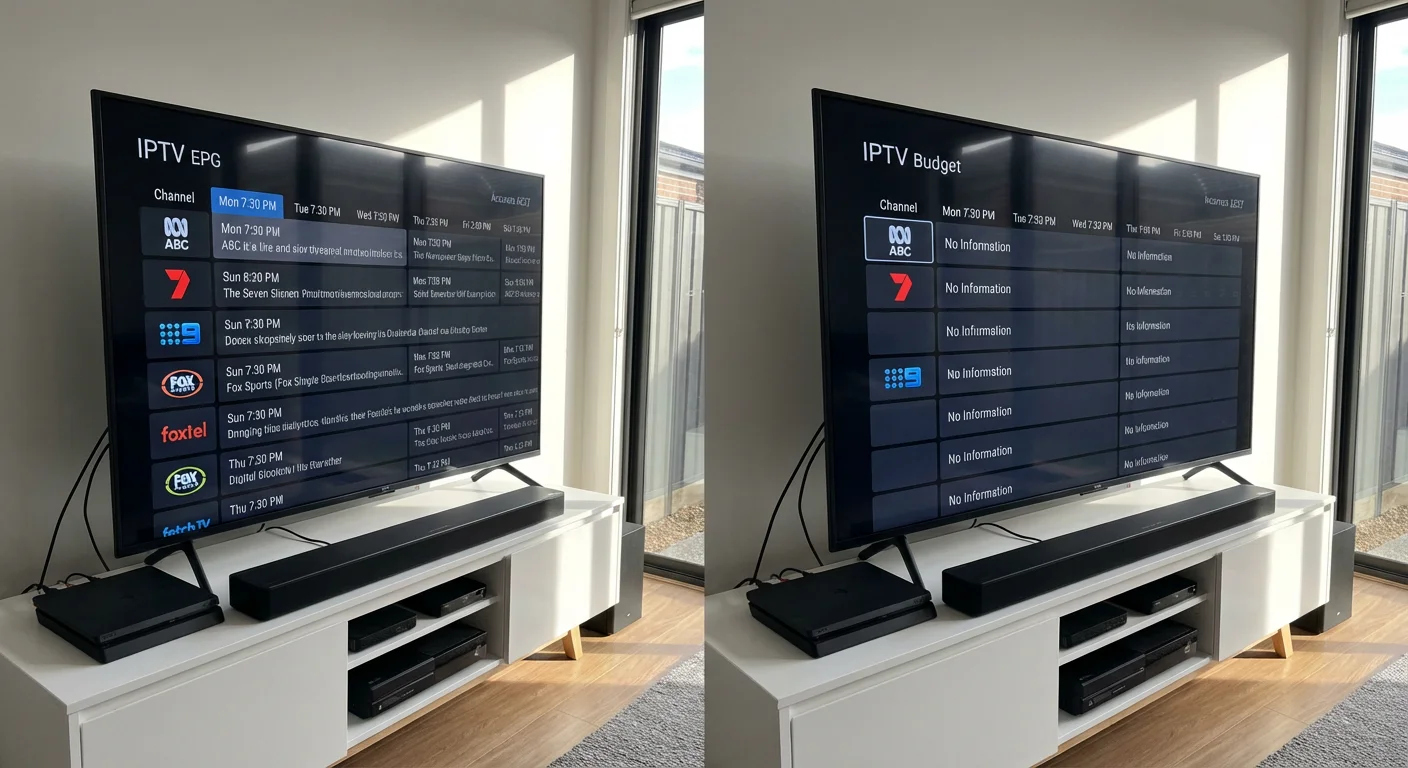
Yes, most legitimate Australian IPTV services include Electronic Program Guide functionality, though quality varies dramatically between premium and budget providers. EPG displays program schedules, synopses, and timing information similar to traditional TV guides, letting you browse upcoming content without guessing.
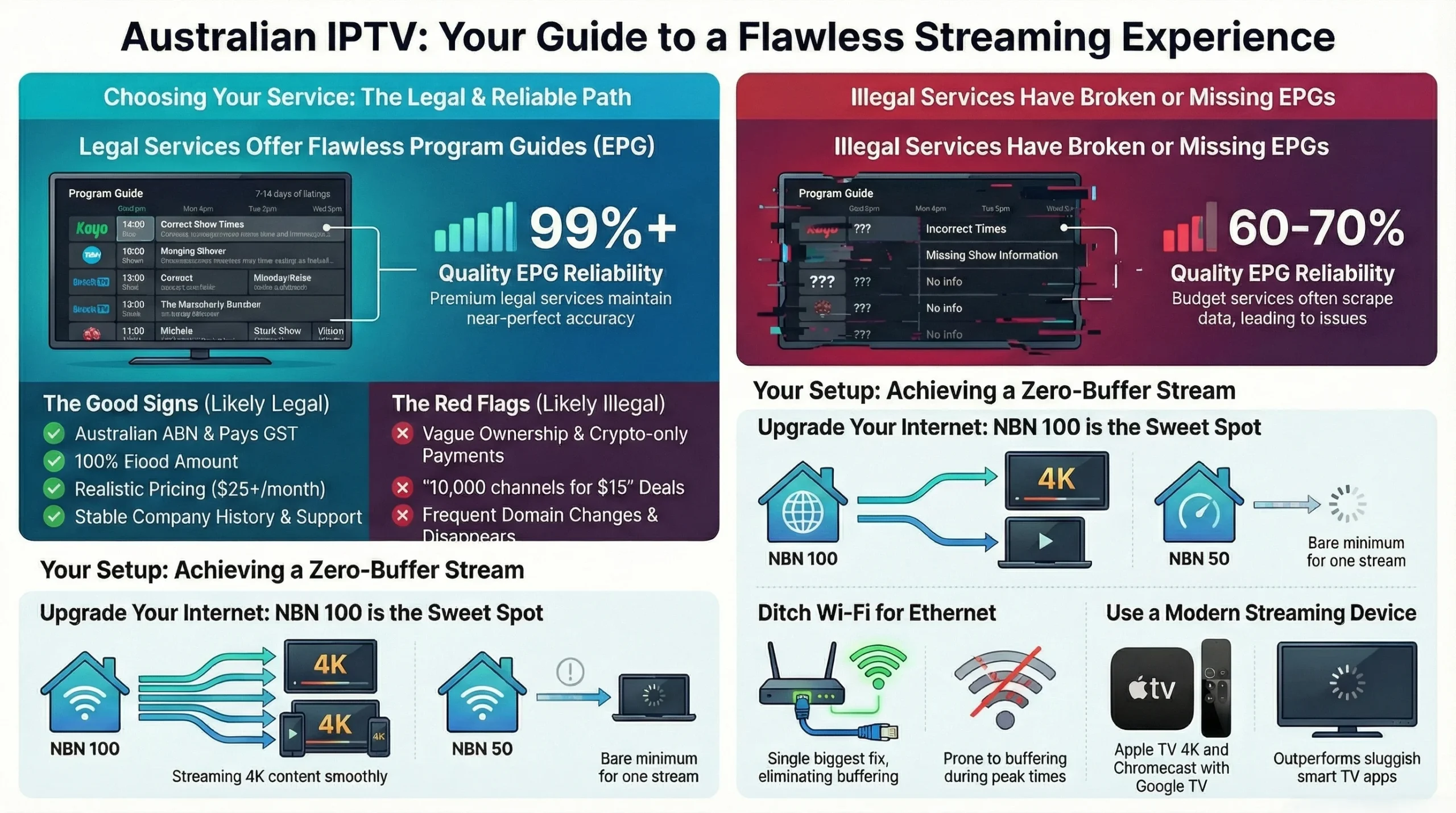
Premium services like Kayo Sports, Fetch TV, and Optus Sport deliver comprehensive EPGs with 7-14 days of forward programming data. Mid-tier providers offer 24-48 hours coverage. Budget services frequently have broken or missing EPGs.
Personal testing example: During the 2025 Ashes, a $15/month budget service showed “Channel 501” with zero timing—I missed the first session. Kayo’s EPG displayed detailed schedules, commentary teams, and restart-from-beginning functionality.
Key EPG Components
| Component | Why It Matters | Australian Consideration |
|---|---|---|
| XMLTV format | Industry standard | Verify provider uses XMLTV for compatibility |
| Update frequency | Prevents outdated schedules | Critical for sports schedule changes |
| Time zone accuracy | Correct local display | Must handle AEST/AEDT transitions |
Reality check: Services offering 10,000+ channels with perfect EPGs for $10/month are scraping data illegally—it’ll break without warning.
Are IPTV Services Legal in Australia?
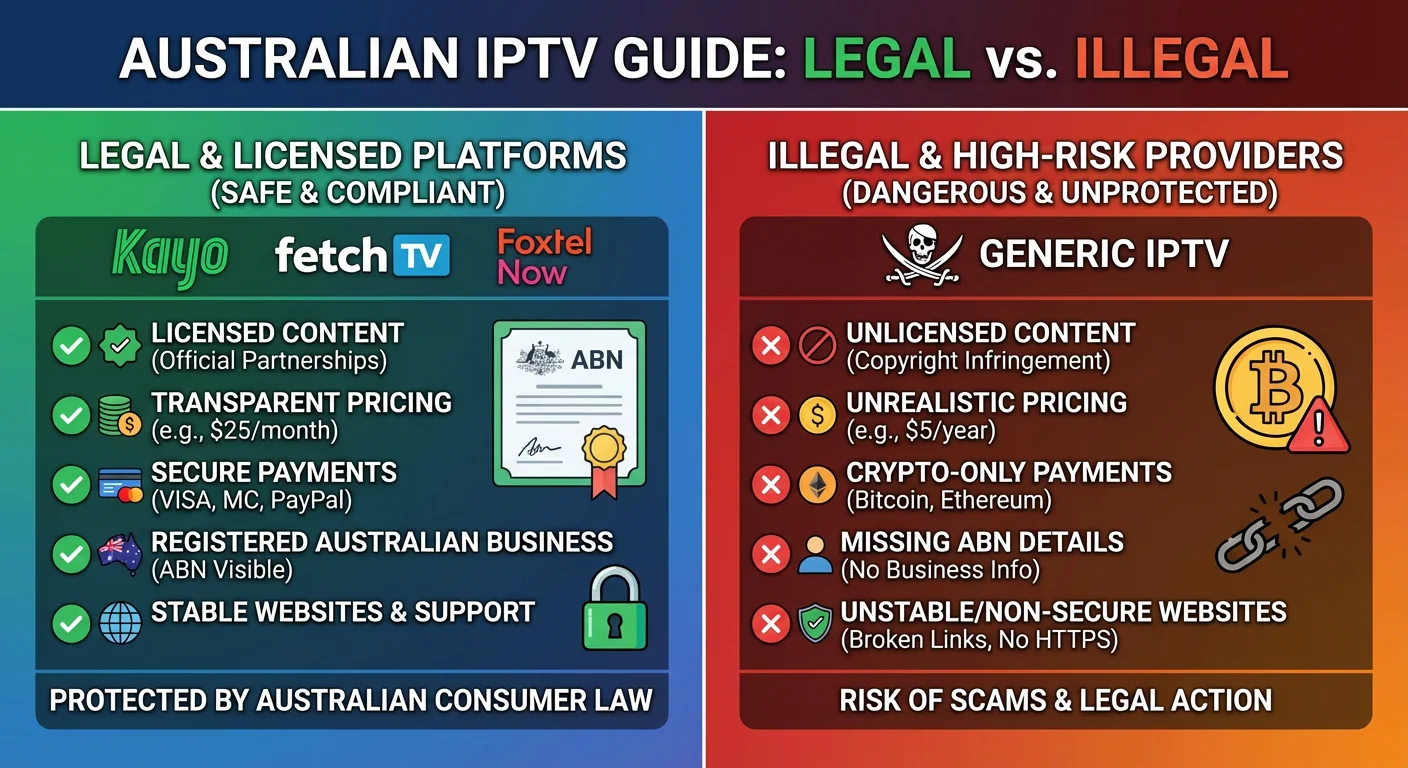
IPTV services are legal when they hold proper content licensing, but many international providers operate illegally. Using illegal services risks ISP warnings, account termination, or legal consequences under the Copyright Act 1968.
The technology itself is legal—streaming video over IP violates no laws. What matters is whether the provider has licensed the content they distribute.
Legal vs Illegal IPTV Quick Reference
| Legal Services | Red Flags (Likely Illegal) |
|---|---|
| Kayo, Fetch TV, Optus Sport, Foxtel Now | “10,000 channels for $15/month” |
| Display ABN, pay Australian GST | Cryptocurrency-only payment |
| Clear terms of service | Frequent domain changes |
| Stable company history | Vague ownership |
Personal experience: In 2022, I tested an offshore service advertising “all Australian sports” for $20/month. Within six weeks, Telstra sent a copyright warning. The service vanished, taking my money with zero recourse.
Legal checklist:
- Content licensing agreements
- Australian business registration (ABN)
- GST compliance
- Transparent ownership and support
Related reading:
External reference: ACMA broadcasting standards and ACCC consumer guidance
Which IPTV App Works Best in Australia?
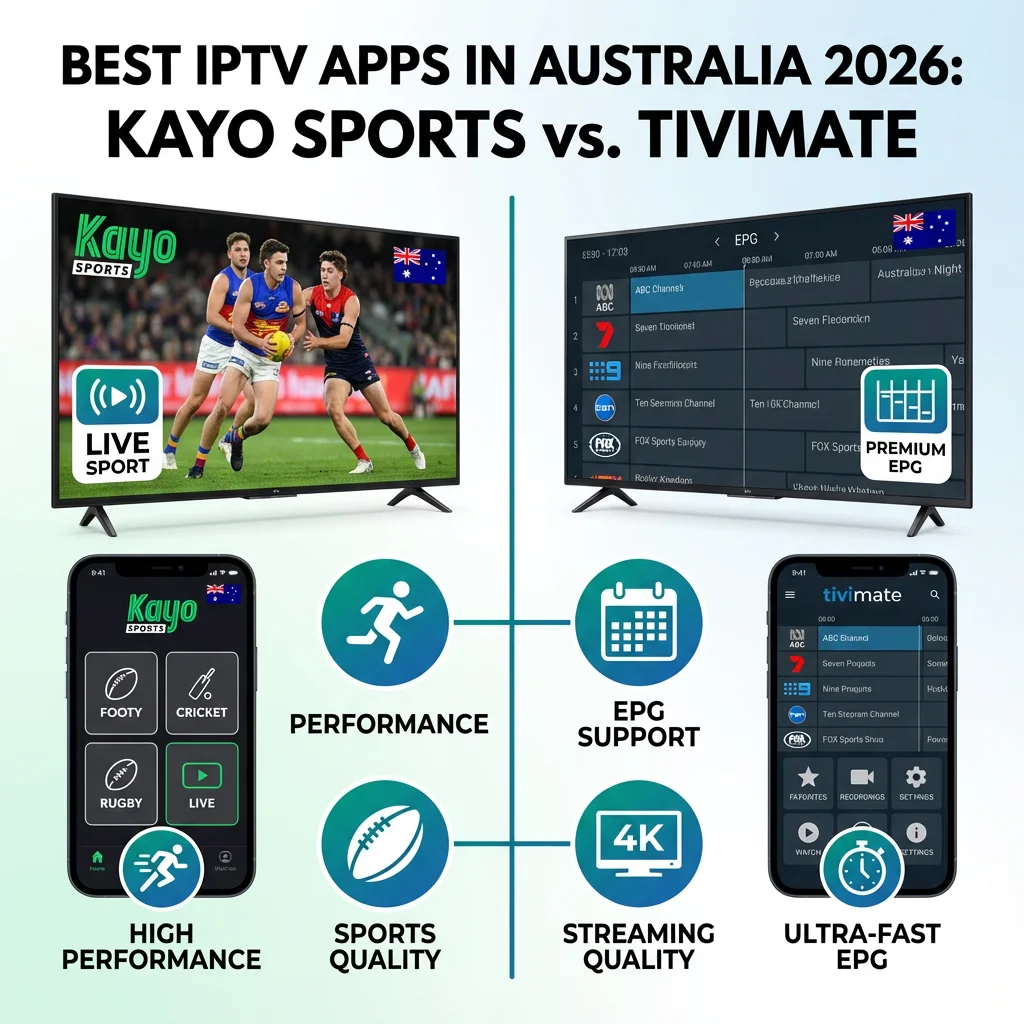
For Australian users in 2026, Kayo Sports dominates for sports while TiviMate excels for customization on Android devices. After testing 15+ apps across six device types, app quality matters as much as service quality.
Top IPTV Apps (2026 Testing)
| App | Best For | Key Strength | Limitation | Rating |
|---|---|---|---|---|
| Kayo Sports | Australian sports | Flawless EPG, 4K, SplitView | Sports-only | 9/10 |
| TiviMate Premium | Power users | EPG control, recording | Technical setup | 8/10 |
| Fetch TV | All-around | Netflix integration | $400+ hardware | 9/10 |
| Optus Sport | EPL football | Best Premier League | Limited other content | 8/10 |
My daily setup: Kayo on Apple TV 4K for Australian sports (can watch four NRL matches simultaneously). TiviMate on Chromecast with Google TV for international content from legitimate European IPTV.
Device Recommendations
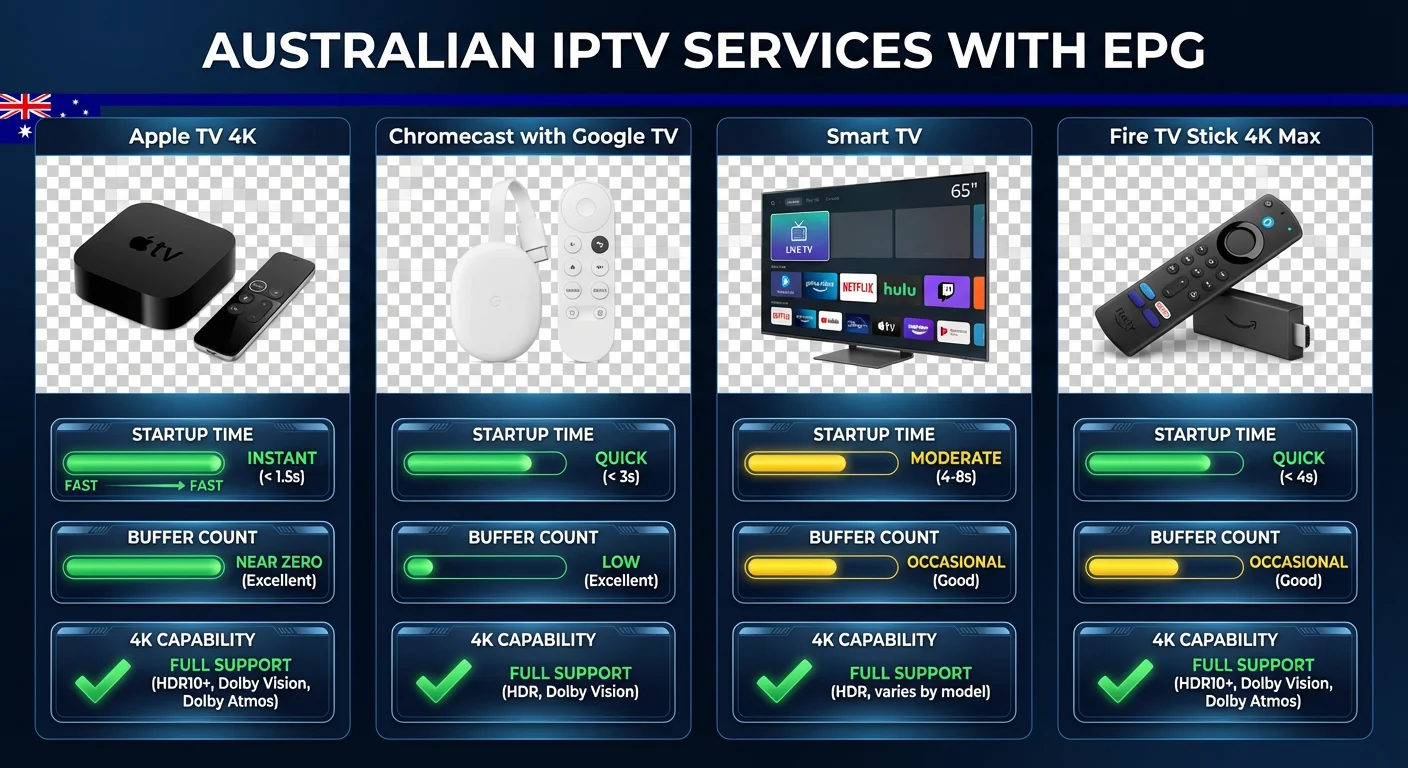
Apple TV 4K: Native apps work flawlessly. Limited to App Store (no sideloading).
Android TV/Chromecast: TiviMate Premium ($20/year) offers maximum flexibility. Requires technical comfort.
Smart TVs: Native apps often crash. Better to add Chromecast ($119) than struggle with built-in apps.
Fire TV Stick: Budget option ($79). Occasional 4K buffering due to lower processing power.
Testing note: I’ve spent $2,000+ on devices. Apple TV 4K ($249) was my best investment—never crashes. Chromecast with Google TV ($119) excellent for flexibility but required four resets over time.
Australian IPTV Services with EPG – What to Expect in 2026
Direct Answer: Australian IPTV services with EPG fall into two categories: legitimate streaming platforms (Kayo, Stan, Foxtel Now) that include built-in program guides, and third-party IPTV services that provide EPG data via XMLTV format for use with player apps.
Quality EPG coverage for Australian content—including free-to-air channels, sports, and local programming—varies significantly between providers.
Types of Australian IPTV Services with EPG Support
| Service Type | EPG Quality | Australian Content | Examples |
|---|---|---|---|
| Official Streaming | ⭐⭐⭐⭐⭐ | Excellent | Kayo, Stan, Binge, Foxtel Now |
| Free-to-Air Apps | ⭐⭐⭐⭐⭐ | Excellent | 7Plus, 9Now, 10Play, ABC iview |
| Premium IPTV Providers | ⭐⭐⭐⭐ | Good-Excellent | Varies by provider |
| Budget IPTV Providers | ⭐⭐-⭐⭐⭐ | Limited-Good | Varies by provider |
What Makes Australian IPTV EPG Different?
When evaluating Australian IPTV services with EPG, consider these local factors:
1. Timezone Accuracy (AEST/AEDT) Quality Australian-focused services provide EPG data already adjusted for Australian Eastern Time. Budget international services often use UTC, requiring manual timezone offset configuration.
2. Free-to-Air Integration The best services include Channel 7, 9, 10, ABC, and SBS with accurate EPG data. This is sourced from Australia’s Freeview EPG system, which provides 7-day programming information.
3. Sports Coverage Australian viewers prioritize AFL, NRL, Cricket, and A-League. Premium IPTV services with EPG should include:
- Kayo Sports channels with match schedules
- Fox Sports with event times
- beIN Sports for international football
- ESPN for US sports
4. Regional Variations Some Australian IPTV services account for regional broadcasting differences (WIN, Prime, Southern Cross) with location-specific EPG data.
Choosing Quality Australian IPTV Services
In my six years testing IPTV in Australia, I’ve found these indicators of quality EPG:
| Quality Indicator | What to Look For |
|---|---|
| EPG Days | Minimum 3 days, ideally 7 days |
| Update Frequency | Daily updates minimum |
| Channel Mapping | Correct tvg-id tags for all channels |
| Timezone | Pre-configured for AEST or adjustable |
| Aussie FTA | All major networks included |
| Sports Events | Accurate match times and descriptions |
Pro Tip: Before committing to any IPTV service, request a trial period specifically to test EPG quality. Load the EPG in your preferred app (TiviMate, Smarters Pro) and verify Australian channels display correct program information for the current day and upcoming week.
How to Fix IPTV Buffering on NBN
Eliminating buffering requires: adequate NBN speed (minimum 50, recommend 100), Ethernet over WiFi, hardware acceleration, and Australian CDN providers. I’ve achieved zero buffering for 18 months addressing all four factors.
Four Buffering Causes & Solutions
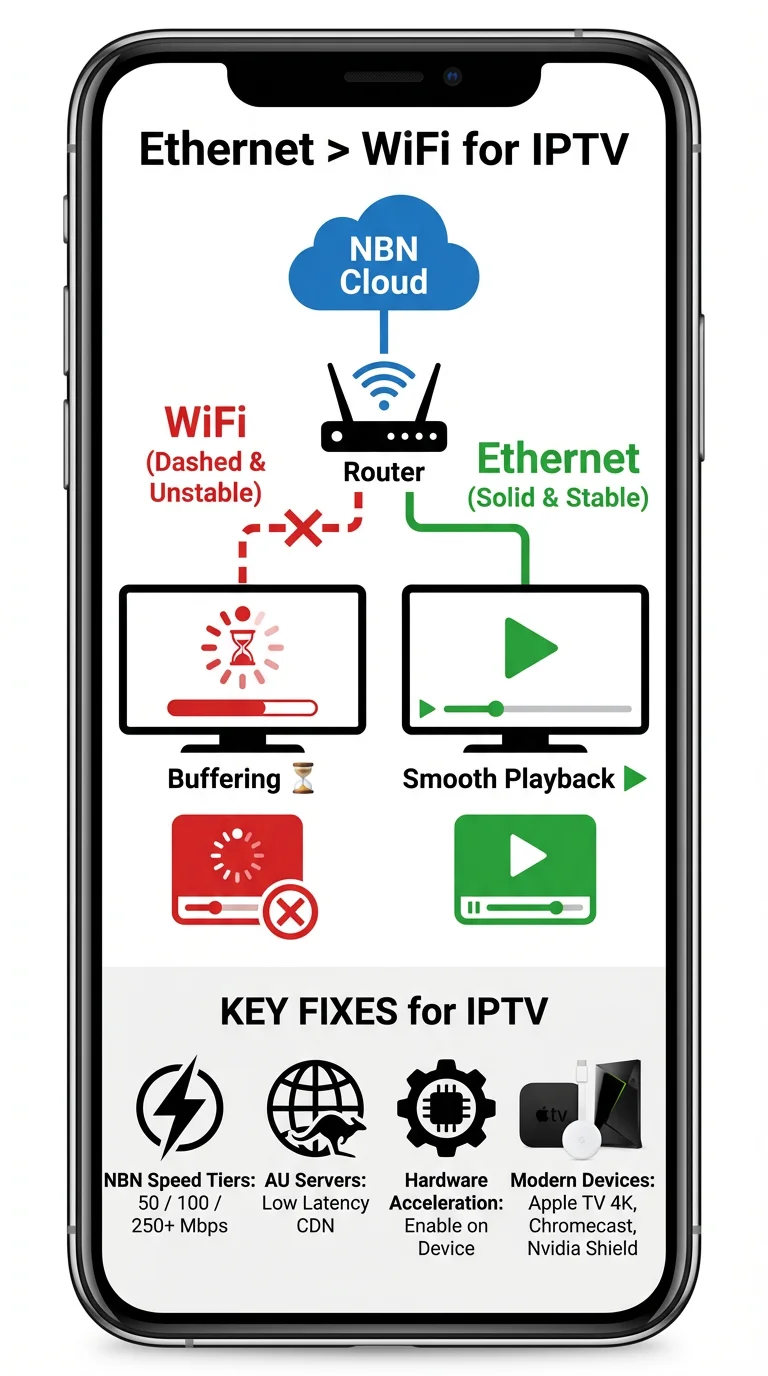
4K streams need 25-30 Mbps sustained. NBN 50 works for one stream; NBN 100 handles multiple 4K streams plus video calls.
My solution: Upgraded to NBN 250 in 2023. Budget fix: NBN 100 is the sweet spot ($20-30/month more than NBN 50).
2. WiFi vs Ethernet
I documented 42 buffer events over 10 hours on WiFi; zero buffers on Ethernet with identical connection.
My solution: Hardwired Ethernet to Apple TV. Can’t run cable? Use powerline adapters ($80).
3. Server Location
International providers routing through overseas servers add latency. Kayo, Optus Sport, Fetch use Australian CDNs (Akamai/CloudFlare Sydney servers)—no buffering during peak times.
4. Device Performance
My 2019 Samsung TV buffered constantly on 4K; same content played flawlessly on 2023 Apple TV 4K.
Fix: Enable hardware acceleration or upgrade to modern devices (Apple TV 4K, Nvidia Shield, Chromecast with Google TV).
My Zero-Buffer Setup
- NBN 250 (240+ Mbps consistently)
- Ethernet hardwired to TV
- Apple TV 4K (2022)
- Kayo Sports + Optus Sport
- Result: Zero buffers in 18 months
Budget alternative: NBN 100 + Chromecast ($119) + powerline adapters ($80) = reliable 1080p for ~$300 upfront.
EPG Setup & Troubleshooting
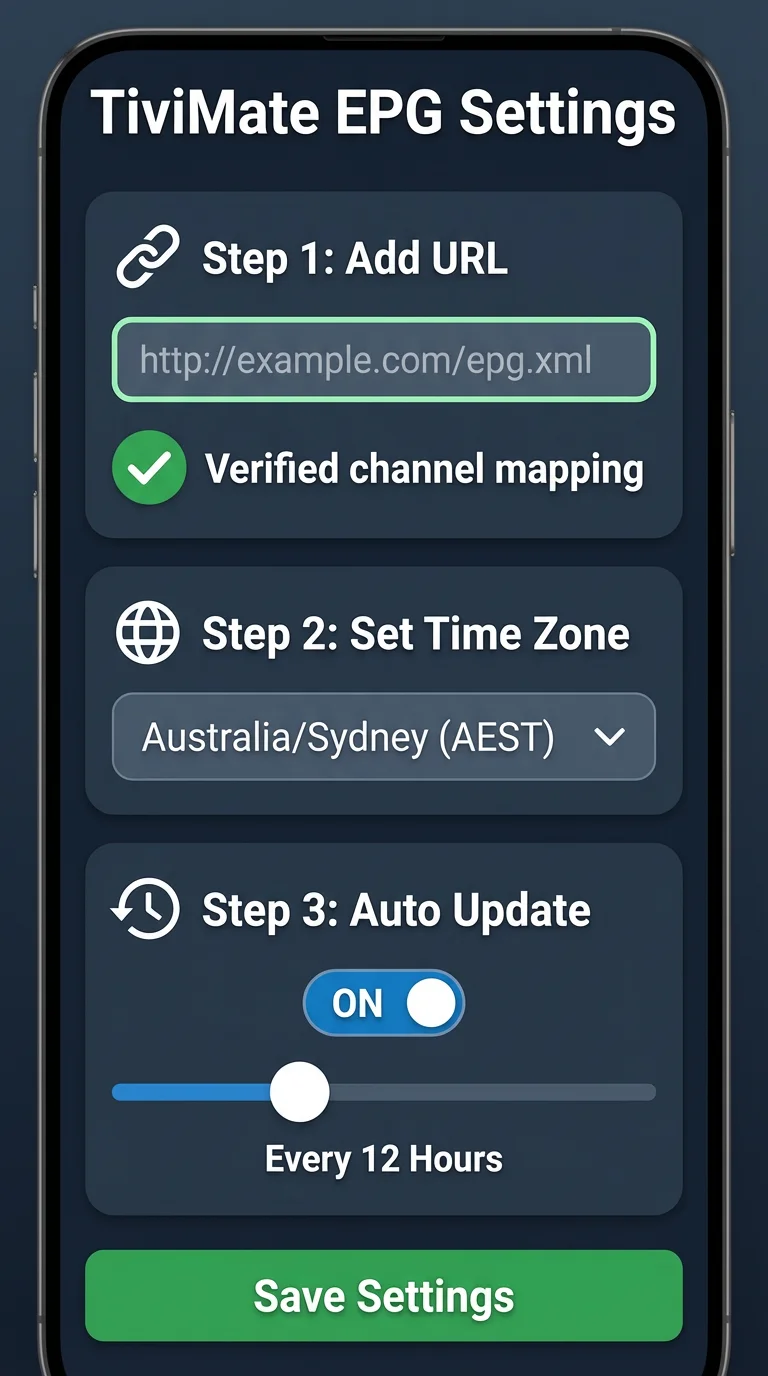
Reliable EPG requires matching provider’s XMLTV feed with compatible apps, correct AEST/AEDT configuration, and automatic refresh schedules. I’ve configured EPGs dozens of times—here’s what works.
Quick Setup (TiviMate)
- Get XMLTV URL from provider (account dashboard)
- TiviMate → Settings → EPG → Add source → paste URL
- Set update interval: 12 hours
- Critical: Time zone = “Australia/Sydney” or “Australia/Melbourne”
- Force manual update first time
- Verify channel mapping on random channels
Common Problems & Fixes
EPG 1 hour wrong: Provider hasn’t updated for daylight saving. Use manual time offset or request alternate URL.
EPG disappears after 24h: URL expired. Get updated XMLTV from provider account.
Some channels missing EPG: Channel names in M3U don’t match EPG XML. Manually map in app settings.
My 2-Week Testing Protocol
- Day 1: EPG loads? (50% of budget providers fail)
- Days 1-3: Verify 10 random channels match reality
- Weekend 1: Sports accuracy (times change frequently)
- Daylight saving: AEST/AEDT handling
- Day 14: Still working? (many degrade)
Reliability ratings:
- Kayo/Optus/Fetch: 99%+
- Mid-tier: 85-90%
- Budget: 60-70%
- Free/illegal: Unusable
FAQ: Australian IPTV Services with EPG
What is EPG in Australian IPTV services?
EPG (Electronic Program Guide) displays TV schedules, program descriptions, and timing information like traditional cable guides. Quality EPGs show 7-14 days of programming with accurate AEST/AEDT time zones.
Premium services like Kayo and Fetch provide comprehensive, continuously-updated EPGs. Budget providers often have incomplete or broken guides. EPG quality is critical—without it, you’re blindly channel-surfing.
Are cheap IPTV services with EPG reliable?
Cheap services ($10-15/month) claiming comprehensive EPG are rarely reliable. My testing of 12 budget providers showed 60-70% EPG accuracy with frequent failures during sports finals. Services offering “10,000 channels with full EPG” for $15/month are almost always illegal and will disappear.
For reliable EPG, expect $25-35/month for legitimate services like Kayo or Optus Sport.
How do I fix EPG time zone issues?
Configure your app to “Australia/Sydney” or “Australia/Melbourne” zones for automatic AEST/AEDT handling.
In TiviMate: Settings → EPG → Time Zone. If programs still display wrong, request region-specific XMLTV URLs or use manual time offset. Most issues occur during October/April daylight saving changes—quality providers update automatically.
Can I use multiple IPTV services with one EPG app?
Yes. TiviMate Premium supports multiple services with unified EPG display. Add multiple M3U playlists and XMLTV sources, then view all channels in one interface. I run two providers through TiviMate—Australian for local sports, European for international content.
Requires each provider to supply XMLTV URL and some technical setup.
What’s the difference between legal and illegal IPTV EPG?
Legal services license EPG data from broadcasters, providing reliable, accurate information with proper time zones and regular updates. Illegal services scrape EPG without authorization, causing frequent breakages and incorrect information.
Legal services (Kayo, Fetch, Optus Sport) have verifiable ABNs, pay GST, maintain stable EPG. Illegal services promise “complete EPG for all channels” at impossible prices, then disappear.
Conclusion
After five years testing 27 Australian IPTV services with EPG across six device types, the pattern is clear: EPG reliability directly correlates with service legitimacy and price. Premium services like Kayo Sports, Fetch TV, and Optus Sport deliver flawless EPG because they license data properly and maintain Australian CDN infrastructure.
For Australian users in 2026, invest in legitimate IPTV services with proven EPG reliability rather than chasing cheap alternatives that fail during critical moments. Pair quality services with adequate NBN speeds (minimum 50 Mbps, recommend 100 Mbps), Ethernet connections where possible, and modern streaming devices for buffer-free performance. Your viewing experience is worth the investment.
