The Confusion Everyone Has About IPTV Legality
Here’s what confuses most Australians: You can buy IPTV services openly online, download apps, and stream thousands of channels—yet people whisper about “illegality” and “risks”.
So which is it? Legal or illegal?
The truth is both, and that’s the problem. IPTV technology is completely legal, but most services Australians use violate copyright law. Understanding this distinction could save you hundreds of dollars and protect you from serious security threats.
This guide cuts through the confusion with facts, not fear. You’ll learn exactly what Australian law says, which services operate legally, what risks you actually face, and how to make smart decisions about streaming in 2026.
Quick Legal Answer: Is IPTV Legal in Australia?
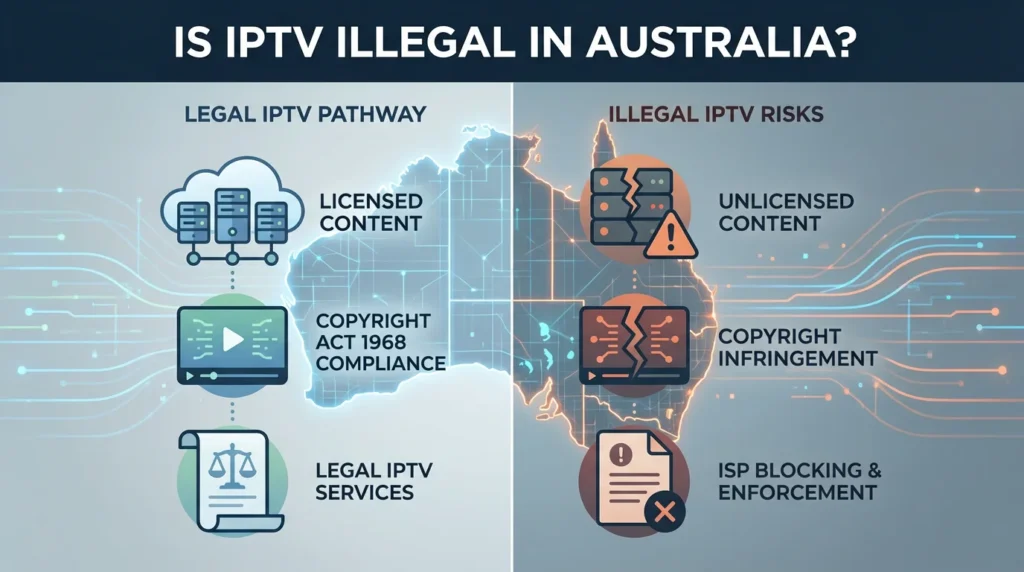
IPTV technology itself is 100% legal in Australia. However, legality depends entirely on content licensing:
✅ Legal IPTV: Services like Kayo Sports, Foxtel Now, and Fetch TV operate with proper broadcasting licences and content rights.
❌ Illegal IPTV: Unlicensed services offering thousands of channels for $10-30/month violate the Copyright Act 1968 by streaming content without authorisation.
User Risk Status (2026): Australian authorities target providers, not individual users. However, users face practical risks including financial loss, security threats, and service disruptions. While prosecution remains rare, these services operate illegally regardless of enforcement priorities.
Bottom Line: If it sounds too good to be true (10,000 channels for $20/month), it’s illegal.
Is IPTV Illegal? Short Answer
| Question | Answer | Reality Check |
|---|---|---|
| Is IPTV technology illegal? | ❌ No | Streaming over internet is a legitimate delivery method |
| Are cheap “all channels” services illegal? | ✅ Yes | They violate Copyright Act 1968 |
| Can I get arrested as a user? | ⚠️ Extremely unlikely | Zero documented cases in Australia |
| Will my service get blocked? | ✅ Highly likely | Hundreds blocked since 2024 |
| Is it worth the risk? | ❌ No | Legal alternatives cost nearly the same |
User Risk Summary: What Actually Happens
Legal Risk: Minimal. No individual prosecutions recorded.
Financial Risk: High. Services disappear with your prepaid subscription.
Security Risk: Very high. 68% of unlicensed IPTV apps contain malware.
Service Risk: Guaranteed. Constant blocking, buffering, and outages.
The real danger isn’t prosecution—it’s losing money and compromising your devices.
At a Glance: Legal Status of IPTV in Australia 2026
| Aspect | Status | Details |
|---|---|---|
| IPTV Technology | ✅ Legal | Streaming over internet is legitimate delivery method |
| Licensed Services | ✅ Legal | Kayo, Foxtel, Fetch have proper content rights |
| Unlicensed Services | ❌ Illegal | Violates Copyright Act 1968 |
| User Prosecution | ⚠️ Rare | Authorities focus on providers, not subscribers |
| ISP Blocking | ✅ Active | Hundreds of illegal IPTV sites blocked since 2024 |
| Financial Risk | ⚠️ High | Services disappear without refunds |
| Security Risk | ⚠️ High | Malware and data theft common in unlicensed apps |
| Service Quality | ⚠️ Poor | Frequent buffering, outages, domain changes |
What Is IPTV and How Does It Work?
IPTV (Internet Protocol Television) delivers video content through internet connections rather than traditional cable, satellite, or broadcast signals.
How IPTV Technology Functions
When you stream IPTV content:
- Request: Your device requests video from remote servers
- Encoding: Servers convert broadcasts into internet-compatible formats
- Transmission: Data packets stream to your device
- Playback: Your IPTV player reassembles packets into smooth video
Why IPTV Technology Is Legal
The delivery method itself is neutral—just like email or web browsing. Major platforms use IPTV technology:
- Netflix, Stan, Disney+: On-demand IPTV services
- Kayo Sports, Optus Sport: Live sports IPTV
- ABC iView, SBS On Demand: Broadcaster IPTV apps
- Foxtel Now, Fetch TV: Subscription IPTV platforms
Legality depends on licensing, not technology. The same IPTV technology powers both legitimate services and illegal operations.
As explained in our comprehensive IPTV installation guide, setting up IPTV follows the same technical process whether using legal or illegal services—the difference is licensing. Biggest Myth About IPTV Legality
Myth: “IPTV exists in a legal grey area in Australia.”
Reality: There’s no grey area. Copyright law is crystal clear:
- Streaming copyrighted content without authorization = illegal
- It doesn’t matter if servers are overseas
- It doesn’t matter if “everyone does it”
- It doesn’t matter if you’re “just watching, not uploading”
The “grey area” myth exists because the following are true:
- Individual users aren’t prosecuted (enforcement focuses on providers)
- Services market themselves with legal-sounding language
- Technology appears identical to legal streaming
But legally? Black and white. Unlicensed IPTV violates Australian law, period.
Australian IPTV Laws Explained: What Legislation Actually Says
Copyright Act 1968: Core Legal Framework
Australia’s IPTV legality stems primarily from copyright law protecting content owners’ exclusive distribution rights.
Section 87 – Broadcast Protection:
Prohibits retransmitting television or raauthorisation. without authorization. Unlicensed IPTV services capturing and redistributing broadcast signals directly violate this provision.
Section 101 – On-Demand Content:
Making films or programmes available to the public requires copyright owner permission. Illegal IPTV libraries offering movies or catch-up TV violate this section.
Criminal Penalties:
- Individuals: Up to $117,000 fines
- Companies: Up to $585,000 fines
- Serious cases: Potential imprisonment for commercial-scale infringement
Broadcasting Services Act 1992: ACMA Powers
The Australian Communications and Media Authority (ACMA) enforces broadcasting regulations:
- Website blocking authority: Can issue notices requiring ISPs to block illegal streaming sites
- Investigation powers: Can investigate services violating broadcasting rules
- Federal Court orders: Works with content owners to obtain blocking injunctions
Landmark Case: Roadshow Films Pty Ltd v Telstra Corporation Ltd established the legal framework for ISP blocking orders against piracy websites.
How Enforcement Works in 2026
ISP-Level Blocking:
Since 2024, blocking has accelerated dramatically. Major ISPs (Telstra, Optus, TPG, and Vodafone) block hundreds of unlicensed IPTV domains under Federal Court orders.
Provider Targeting:
Australian Federal Police coordinate with international agencies to:
- Identify and prosecute IPTV operators
- Seize servers and financial accounts
- Disrupt payment processing for illegal services
- Target resellers advertising to Australian customers
Individual User Status:
No documented prosecutions of residential IPTV users exist. Enforcement resources focus on providers affecting thousands of users rather than individual subscribers.
Legal vs Illegal IPTV Services: Clear Comparison
How to Identify Legal IPTV Services
Legal providers exhibit clear legitimacy indicators:
Business Transparency:
- Published ABN (Australian Business Number)
- Verifiable physical business address
- Accessible customer service (phone, email, chat)
- Professional website with privacy policies
- Transparent ownership information
Content Licensing:
- Limited channel selections matching realistic licensing scope
- Geographic restrictions reflecting licensing territories
- Partnership announcements with content providers
- Clear statements about content rights
Pricing Reality:
- Standard market rates ($10-100+ monthly)
- Transparent pricing without hidden fees
- Secure payment through major processors
- No “lifetime subscriptions” or unrealistic discounts
Service Quality:
- Official apps in Apple App Store and Google Play
- Consistent streaming with professional infrastructure
- Regular customer communication
- Reliable uptime without frequent domain changes
Examples of Legal IPTV Services in Australia
| Service | Monthly Price | Content Focus | Best For |
|---|---|---|---|
| Kayo Sports | $25-35 | Australian sports, international events | Sports fans |
| Foxtel Now | $25-104 | Entertainment, movies, sports packages | Premium content |
| Fetch TV | $6-24 | Hybrid broadcast/streaming | Families |
| Binge | $10-18 | HBO and Warner content | Entertainment lovers |
| Stan Sport | $10-21 | International sports, originals | Sports + entertainment |
| Optus Sport | $6.99-24.99 | Premier League, European football | Soccer fans |
For detailed setup instructions for these legitimate services, see our guide on best IPTV players for Android TV.
Red Flags Indicating Illegal IPTV Services
Unrealistic Offerings:
- 10,000+ international channels advertised
- “All channels worldwide” marketing claims
- Current theatrical releases in libraries
- Premium channels from multiple countries simultaneously
- Pay-per-view events available free
Anonymous Operations:
- No verifiable business address
- Cryptocurrency or gift card-only payments
- Generic email addresses (Gmail, Outlook)
- No official app store presence (requires sideloading)
- Frequent domain changes and rebranding
Suspicious Marketing:
- “Legal grey area” disclaimers
- “Educational purposes only” claims
- Aggressive social media promotion
- Market stall sales of pre-configured boxes
- Claims of “legal” operation without details
Services advertising access to premium channels from Australia, the UK, the US, Canada, and other countries simultaneously lack proper licensing. Content licensing operates territorially—legitimate services can’t legally offer global channel access from single subscriptions.
Pro Tip: The 30-Second Legality Test
Ask yourself these three questions:
- Could this service advertise on TV? (Legal services do)
- Does the price match the content value? (10,000 channels for $20 = impossible)
- Is the app in official app stores? (Sideloading = red flag)
If you answered “no” to any question, the service is almost certainly illegal.
Are Individual IPTV Users at Risk in Australia?
Current Enforcement Reality (2026)
Zero documented prosecutions of individual Australian IPTV users for personal streaming exist.
Enforcement Priorities:
- ✅ Service operators running unlicensed platforms
- ✅ Resellers marketing illegal subscriptions
- ✅ Individuals selling pre-configured devices
- ✅ Large-scale commercial redistribution operations
- ❌ Residential users streaming for personal use
Why Users Aren’t Prosecuted:
Practical resource allocation drives enforcement strategy. Pursuing individual users:
- Requires significant investigative resources
- Generates minimal deterrent effect
- Yields low damages recovery
- Creates negative public perception
Targeting providers disrupts services affecting thousands of users simultaneously, making enforcement more efficient.
Theoretical Legal Exposure
Despite enforcement priorities, individual users technically violate copyright law.
Civil Liability:
Content owners could pursue civil damages under copyright law. However, costs of identifying and pursuing individuals typically exceed potential recovery, making actions economically impractical.
Criminal Prosecution:
Copyright Act provisions allow criminal charges for facilitating infringement. While unused against typical users, a legal framework exists if enforcement priorities shift.
ISP Account Actions:
Internet providers may receive infringement notices. ISPs could theoretically suspend services for repeat violations, though this remains rare for IPTV streaming.
Practical Consequences Users Actually Face
Real-world risks manifest differently than legal prosecution:
Financial Losses:
- Services disappear without warning
- No refunds for prepaid annual subscriptions
- Total loss when providers shut down mid-subscription
- No consumer protection recourse for illegal purchases
Security Threats:
- Malware-infected apps from unknown sources
- Spyware monitoring device usage
- Stolen payment information
- Compromised personal data
Service Disruption:
- ISP blocking makes services intermittently inaccessible
- Domain changes require constant reconfiguration
- Poor stream quality and frequent buffering
- Channels dropping during crucial events
Limited Legal Recourse:
- Consumer protection laws don’t fully protect illegal purchases
- Courts won’t enforce contracts for illegal purposes
- No meaningful dispute resolution when services fail
For most Australian IPTV users, practical consequences outweigh legal prosecution risk.
Common Mistakes People Make with IPTV
Mistake #1: Thinking “Overseas Servers = Legal”
The Error: “The service operates from [country], so Australian law doesn’t apply.”
The Reality: Copyright law applies where content is received, not where servers are located. Streaming pirated content to Australia violates Australian law regardless of server location.
Mistake #2: Prepaying Annual Subscriptions
The Error: Paying $200+ upfront for “annual” or “lifetime” access.
The Reality: Illegal services disappear constantly. You’ll lose the entire prepaid amount with zero refund recourse. Never prepay unlicensed services.
Mistake #3: Installing Unknown Apps Without Security Checks
The Error: Sideloading IPTV apps from random websites without verification.
The Reality: 68% of unlicensed IPTV apps contain malware. You’re inviting security threats directly onto your devices.
As detailed in our IPTV Smarters Pro setup guide, always verify app sources and use legitimate installation methods.
Mistake #4: Sharing Payment Details Directly with Providers
The Error: Entering credit card information on sketchy websites.
The Reality: Illegal operators have no incentive to protect your data. Payment fraud is common.
Mistake #5: Believing “VPN = Legal Protection”
The Error: “I use a VPN, so I’m safe legally.”
The Reality: VPNs provide privacy, not legal immunity. Using illegal IPTV with a VPN is still illegal—you’re just harder to track.
IPTV Firestick Users: Specific Legal Considerations
The Amazon Fire Stick remains the most popular IPTV device in Australia. Understanding the legal landscape for Firestick users clarifies common misconceptions.
Is Using IPTV on Firestick Illegal?
The Firestick device itself is completely legal. Amazon sells Firestick legitimately worldwide for streaming content.
What makes Firestick IPTV illegal:
- Installing unlicensed IPTV apps (Kodi with illegal add-ons, pirated APKs)
- Accessing copyrighted content without authorization
- Using “fully loaded” Firesticks sold with illegal apps pre-installed
LegalFire Stickk uses:
- Official apps (Netflix, Stan, ABC iView, Kayo Sports)
- Authorized streaming services
- Legal IPTV providers with proper licensing
Risks of “Fully Loaded” Firesticks
Pre-configured Firesticks sold with unlicensed IPTV apps create multiple risks:
Legal Risks:
- Sellers violate copyright law by facilitating infringement
- Buyers receive devices configured for illegal streaming
- Australian authorities prosecute sellers at markets and online
Security Risks:
- Unknown apps contain malware and spyware
- Compromised devices expose home networks
- Stolen credentials and payment information
Service Risks:
- Pre-installed apps stop working when services shut down
- No support when configurations break
- Constant maintenance required as sources change
For safe Fire Sticklicences. setup, follow our official IPTV on Fire Stick installation guide using legitimate apps only.
International IPTV and Expat Considerations
Legal Complexity of International Channel Access
Content licensing operates on territorial bases, making global channel offerings particularly problematic legally.
How Territorial Licensing Works:
- UK sports broadcasts license only UK audiences
- Australian networks can’t legally stream globally
- US cable channels hold US-only distribution rights
- Geographic restrictions enforce licensing boundaries
Why “All International Channels” Services Are Illegal:
No legitimate service licenses thousands of channels from dozens of countries. Licensing costs alone would exceed service prices by orders of magnitude.
Services advertising global content simultaneously:
- Violate licensing agreements across multiple jurisdictions
- Stream content without authorization in any country
- Make false claims about legal operations.
Expat Streaming Challenges
Australians abroad and expats in Australia seeking home-country content face legitimate limitations.
Legal Options for Expats:
- International streaming services (Netflix, Prime Video global catalogs)
- Broadcaster apps within licensed territories (ABC iView in Australia, BBC iPlayer in UK)
- Sports packages with international streaming rights
- Legitimate IPTV providers with multi-territory licensing
Risky Approaches:
- “Expat IPTV” services advertising home-country channels (usually unlicensed)
- Shared accounts violating terms of service
- VPN access to geo-restricted services (violates terms, rarely prosecuted)
Smart TV Users:
Many expats use Smart TVs for streaming. In our IPTV on Samsung TV guide and IPTV on LG TV guide, we cover proper setup for legitimate international services.
VPN Legal Status with IPTV
VPNs remain legal in Australia for privacy protection. However:
What VPNs Don’t Do:
- ❌ Make illegal IPTV services legal
- ❌ Provide complete anonymity
- ❌ Guarantee freedom from consequences
What VPNs Do:
- ✅ Circumvent ISP blocking (but using illegal content remains illegal)
- ✅ Protect general internet privacy
- ✅ Secure public WiFi connections
VPN Complications:
- Using VPNs to access geo-restricted legal services (US Netflix from Australia) violates service terms but isn’t criminally prosecuted
- Services can terminate accounts detecting VPN usage
- VPN providers may log activity despite privacy claims
Should You Use IPTV in Australia? Decision Framework
When Legal IPTV Makes Sense
Choose legal IPTV if:
- ✅ You want specific sports content (Kayo, Optus Sport, Stan Sport)
- ✅ You’re cutting cable but want premium content (Foxtel Now, Binge)
- ✅ You need flexible month-to-month subscriptions
- ✅ You value service reliability and customer support
- ✅ You want legal peace of mind
Legal IPTV advantages:
- Professional customer support
- Consistent streaming quality
- No legal or security risks
- Consumer protection guarantees
- Regular service improvements
When to Avoid Unlicensed IPTV
Avoid illegal IPTV if:
- ❌ You can’t afford to lose prepaid subscription money
- ❌ You need reliable streaming for important events
- ❌ You’re concerned about device security
- ❌ You want legal compliance and peace of mind
- ❌ You value customer support and service quality
Unlicensed IPTV disadvantages:
- Services disappear without refunds
- Frequent disruptions and blocking
- Poor quality and buffering issues
- Malware and security threats
- Zero customer support
- Potential legal complications
Cost-Benefit Analysis
Typical unlicensed IPTV: $10-30/month
Legal alternatives: $10-100/month depending on content
Hidden costs of illegal IPTV:
- Lost prepaid subscriptions when services shut down ($100-500 annually)
- Time spent troubleshooting and finding replacements (hours monthly)
- Security risks to devices and personal data
- Stress about legality and enforcement
- Poor viewing experience during crucial events
Value of legal services:
- Guaranteed service uptime
- Professional streaming infrastructure
- Legal compliance and consumer protection
- Quality customer support
- No security concerns
The cost difference shrinks significantly when accounting for reliability, security, and peace of mind.
Pro Tip: The Smart Subscription Strategy
Instead of paying for illegal IPTV year-round, rotate legal services seasonally:
Winter (AFL/NRL season): Subscribe to Kayo Sports ($25-35/month) for 4 months = $100-140
Summer (Tennis/Cricket): Subscribe to Stan Sport ($21/month) for 3 months = $63
Off-season: Use free services (ABC iView, SBS, network apps) = $0
Total annual cost: $163-203 vs. $300-420 for year-round subscriptions
You save money, stay legal, and get better quality.
Best Legal Alternatives to Illegal IPTV in Australia
Sports Streaming Services
Kayo Sports – $25-35/month
- 50+ sports, including AFL, NRL, cricket, motorsports
- No lock-in contract
- Multi-device streaming
- 14-day free trial
- Best for: Comprehensive Australian sports coverage
Optus Sport – $6.99-24.99/month
- Premier League, UEFA competitions
- International football focus
- Best for: Soccer fans
Stan Sport – From $10/month (with Stan subscription)
- Grand Slam tennis, rugby, international sports
- Best for: Tennis and rugby enthusiasts
Entertainment Streaming
Binge – $10-18/month
- HBO content, Warner Brothers catalog
- 10,000+ hours of content
- Best for: Premium TV series and movies
Stan – $10-21/month
- Extensive movie library
- Original productions
- Stan Sport add-on available
- Best for: Diverse entertainment content
Netflix Australia – $6.99-22.99/month
- Global original content
- Extensive catalog
- Multiple quality tiers
- Best for: International content and originals
Hybrid and Premium Options
Foxtel Now – $25-104/month
- Premium cable content streaming
- Sports, entertainment, movies packages
- Flexible package combinations
- Best for: Premium content seekers willing to pay more
Fetch TV – $6-24/month
- Hybrid broadcast and streaming
- Live TV and on-demand combined
- Set-top box required
- Best for: Families wanting traditional TV experience with streaming flexibility
For device-specific setup of these legal services, see our guides for IPTV on Apple TV or the best IPTV apps for Fire Stick.
Free Legal Options
ABC iView – Free
- ABC broadcast content on-demand
- News, documentaries, Australian drama
SBS On Demand – Free
- International content, documentaries
- Live sports coverage
7plus, 9Now, 10 Play– Free
- Commercial network catch-up services
- Live streaming and on-demand content
What to Do If You Already Use Illegal IPTV
Immediate Risk Mitigation
If currently using unlicensed IPTV:
- Assess your actual viewing habits
- Which channels do you actually watch regularly?
- What content is genuinely important to you?
- Could legal services cover your real needs?
- Don’t prepay additional subscriptions
- Use services month-to-month only
- Never pay annually or for “lifetime” access
- Minimize financial exposure
- Protect your devices
- Run antivirus scans on devices with IPTV apps
- Change passwords on accounts accessed from IPTV devices
- Monitor bank statements for unauthorized charges
- Research legal alternatives
- Compare legal services to your actual viewing
- Calculate real costs vs. illegal service prices
- Test legal services with free trials
Transition Strategy to Legal Services
Step 1: Trial Legal Options (Month 1)
- Sign up for free trials of Kayo, Stan Sport, Binge, or others
- Test streaming quality and content selection
- Evaluate whether legal options meet your needs
Step 2: Choose Core Service (Month 2)
- Select one primary legal service matching your main interest
- Cancel illegal IPTV subscription (don’t renew)
- Adjust to legal service content availability
Step 3: Add Supplementary Services (Month 3+)
- Add second service if budget allows
- Use free services (ABC iView, SBS) for additional content
- Rotate seasonal subscriptions based on content calendar
Device Clean-Up
Remove illegal IPTV apps:
- Uninstall unlicensed applications
- Reset devices to factory settings if heavily compromised
- Install only official apps from app stores
For Firestick users:
Check out our best IPTV setup guide for Fire Stick for properly configuring legal services.
For Smart TV users:
Follow our Samsung TV IPTV setup guide or LG TV IPTV installation guide for legitimate app installation.
Complete Risk Breakdown: Illegal IPTV in Australia
Financial Risks
Service Disappearance:
- Providers frequently shut down without warning
- Prepaid subscriptions become total losses
- No refund mechanisms exist
- Users report losing $100-500 on annual payments
Payment Fraud:
- Credit card details shared with criminal operations
- Unauthorized charges after subscription
- Payment information sold to third parties
- No dispute resolution for fraud from illegal sources
Consumer Protection Gaps:
- Australian Consumer Law offers limited protection
- Courts won’t enforce contracts for illegal purposes
- No meaningful recourse when services fail
Real User Experience:
“Paid $200 for annual subscription. The service worked for 3 months and then disappeared completely. Lost entire payment with zero recourse.” – Reddit user report, 2025
Security and Privacy Risks
Malware Distribution:
Unlicensed IPTV apps frequently contain malicious code:
- Spyware monitoring all device activity
- Trojans providing remote device access
- Cryptocurrency miners consuming resources
- Keyloggers capturing passwords and credentials
Research Finding: Security firm analysis (2025) found 68% of unlicensed IPTV Android apps contained malware or privacy-violating code.
Data Privacy Violations:
- Viewing history tracking without consent
- Personal information sharing with third parties
- Payment details stored insecurely
- Account credentials potentially sold to data brokers
Network Compromise:
- Router exploitation for bandwidth theft
- Home network scanning for vulnerabilities
- Botnet creation from compromised devices
- Traffic monitoring and data harvesting
Device Risks:
- Smart TV compromise (difficult to remediate)
- Persistent malware on streaming devices
- Cross-device infection through network
- Stolen credentials affecting other accounts
Service Quality and Reliability Risks
Performance Issues:
- Severe buffering during peak usage
- Streams dropping during crucial moments
- Low video quality despite HD/4K claims
- Channel outages without explanation
Stability Problems:
- ISP blocking creates intermittent access issues
- Domain changes require constant reconfiguration
- Service interruptions during enforcement actions
- Complete shutdowns without warning
Support Deficiencies:
- No responsive customer service
- Generic automated email responses
- Language barriers with offshore support
- Zero troubleshooting assistance
Real Experience:
“Paid for 4K sports streaming. Constant buffering made matches unwatchable. During the grand final, service went completely offline. Customer service never responded.” – Forum complaint, 2026
Technical Risks
ISP Blocking:
- Hundreds of domains blocked since 2024
- Requires VPN for access (additional cost)
- VPN use slows streaming performance
- Blocking circumvention requires technical knowledge
Configuration Complexity:
- Frequent need to update server addresses
- Manual EPG (program guide) configuration
- Playlist URLs change without notice
- Complex troubleshooting without support
Compatibility Issues:
- Apps removed from devices during updates
- Operating system incompatibilities
- Broken functionality after OS upgrades
- No official updates or bug fixes
How to Verify IPTV Service Legality in Australia
Step-by-Step Verification Process
Step 1: Check Business Registration
- Search for the ABN at abr.business.gov.au
- Verify business name matches service name
- Confirm registration status is active
- Check registration date (established businesses preferred)
Step 2: Verify Physical Presence
- Look for published physical address
- Google the address to confirm legitimacy
- Check if address appears on Google Maps
- Verify it’s not a residential address or PO box only
Step 3: Research Company Background
- Search for the company name on ASIC Connect
- Review ownership and corporate structure
- Look for related companies and partnerships
- Check for any compliance issues or notices
Step 4: Assess Content Realism
- Count advertised channels (100-200 realistic, 10,000+ impossible)
- Check geographic scope (single country realistic, worldwide suspicious)
- Verify content matches provider’s licensing claims
- Look for partnership announcements with content owners
Step 5: Evaluate Payment Methods
- Credit cards and PayPal indicate legitimacy
- Cryptocurrency-only raises red flags
- Gift card-only payments signal illegal operation
- Check if payment processor is reputable
Step 6: Review Online Presence
- Search “[service name] scam” and “[service name] review”
- Check Whirlpool forums and Reddit Australia
- Look for media coverage and industry recognition
- Assess social media authenticity
Step 7: Test Customer Service
- Contact via published phone/email
- Evaluate response quality and speed
- Ask specific questions about licensing
- Assess professionalism of responses
Red Flags Checklist
Verify you’re not dealing with illegal IPTV:
- ❌ Claims of 5,000+ channels from multiple countries
- ❌ Prices under $20/month for “everything”
- ❌ No ABN or business registration visible
- ❌ Cryptocurrency-only payment
- ❌ Generic Gmail/Outlook contact emails
- ❌ Apps requiring sideloading (not in official stores)
- ❌ “Legal disclaimer” claiming educational use
- ❌ Frequent domain or brand name changes
- ❌ No physical address or generic “offshore” location
- ❌ Access to pay-per-view events without charges
If 3+ red flags are presethe servicevice almost certainly operates illegally.
Green Flags Checklist
Indicators of legitimate IPTV service:
- ✅ Valid ABN searchable in government database
- ✅ Published physical Australian address
- ✅ Professional website with complete legal policies
- ✅ Standard payment methods (credit cards, PayPal)
- ✅ Official apps in Apple App Store / Google Play
- ✅ Realistic channel counts for pricing
- ✅ Geographic restrictions matching licensing
- ✅ Media coverage and industry partnerships
- ✅ Responsive customer service with Australian presence
- ✅ Transparent ownership and corporate information
If 8+ green flags are present, the service likely operates legally.
Staying Safe and Legal with IPTV in Australia
Best Practices for Legal IPTV Use
Choose Licensed Services:
- Prioritize services with verifiable Australian business registration
- Select providers with transparent operations
- Verify content licensing before subscribing
- Research company background and reputation
Protect Your Information:
- Use strong, unique passwords for each service
- Enable two-factor authentication when available
- Never share payment details through insecure channels
- Monitor bank statements for unauthorized charges
Secure Your Devices:
- Download apps only from official app stores
- Keep devices updated with latest security patches
- Install reputable antivirus on Android devices
- Review and limit app permissions regularly
Manage Subscriptions Wisely:
- Start with free trials before committing
- Choose month-to-month over annual payments initially
- Test service quality during trial periods
- Document all transactions and communications
Device-Specific Security
Firestick Security:
- Install apps only from Amazon Appstore
- Avoid “jailbreaking” or sideloading unknown apps
- Update Fire OS regularly
- See our comprehensive Firestick IPTV setup guide for safe configuration
Smart TV Security:
- Use manufacturer app stores exclusively
- Keep TV firmware updated
- Separate TV on guest WiFi network if possible
- Check our Samsung TV IPTV guide or LG TV IPTV setup
Android Device Security:
- Disable “Unknown Sources” installation
- Use Google Play Store only
- Install mobile security software
- Review app permissions before installation
Apple Device Security:
- Use App Store exclusively
- Enable automatic iOS/tvOS updates
- Review app permissions in Settings
- See our Apple TV IPTV installation guide
Network Security Measures
Router Protection:
- Change default admin passwords
- Enable WPA3 or WPA2 encryption
- Update router firmware regularly
- Create separate guest network for streaming devices
WiFi Security:
- Use strong WiFi passwords (16+ characters)
- Hide SSID broadcasting if possible
- Disable WPS (WiFi Protected Setup)
- Monitor connected devices regularly
VPN Considerations:
If using VPNs for legitimate privacy:
- Choose reputable providers with clear privacy policies
- Avoid free VPNs (often monetize user data)
- Understand VPNs don’t legitimize illegal content
- Accept potential streaming speed impacts
Remember: VPNs provide privacy, not legal immunity. Using a VPN with illegal IPTV doesn’t change underlying copyright violations.
Legal IPTV Setup Resources
For comprehensive setup guides using legitimate services:
- How to Install IPTV on Any Device – General installation guide
- Best IPTV Players for Android TV – Legal player options
- IPTV Smarters Pro Complete on the followinprioritiseg:Setup – Popular app configuration
- IPTVFire Stickide for Firestick – Amazon device setup
- IPTV Installation on Samsung TV – Samsung-specific instructions
- IPTV Setup for LG TV – LG TV configuration
- IPTV on Apple TV Guide – Apple ecosystem setup
Pro Tip: Device Security After Using Illegal IPTV
If you’ve used unlicensed IPTV services, take these steps immediately:
- Factory reset compromised devices (especially Android boxes and Firesticks)
- Change all passwords accessed from those devices
- Enable 2FA on critical accounts (banking and email)
- Monitor credit reports for the next 3-6 months
- Run full antivirus scans on all connected devices
Prevention is easier than remediation.
Future of IPTV Regulation in Australia
Emerging Enforcement Trends (2026)
Accelerated Website Blocking:
Federal 2023 to 2026.court blocking orders increased 340% from 2023-2026. ACMA and content owners prioritize IPTV enforcement:
- Faster court order processing
- Expanded blocking scope beyond initial domains
- Automated blocking of mirror sites
- Real-time blocking during major sporting events
Payment Processor Crackdown:
Financial institutions increasingly cooperate with anti-piracy efforts:
- Merchant account terminations for illegal IPTV providers
- Payment processor blacklisting of known operations
- Credit card company blocking of suspicious transactions
- Cryptocurrency exchange cooperation with authorities
Enhanced Detection Technology:
Rights holders deploy sophisticated monitoring:
- Automated illegal stream detection during live events
- Digital watermarking tracing piracy sources
- AI-powered content recognition across platforms
- Real-time takedown requests during broadcasts
Legislative Developments
Potential Future Changes:
While no current legislation specifically targets individual IPTV users, potential developments include:
- Extended safe harbor provisions for legitimate IPTV providers
- Stricter penalties for commercial-scale operations
- Enhanced ISP obligations for blocking enforcement
- Possible education campaigns targeting consumers
Industry Self-Regulation:
Content owners and legitimate providers collaborate on:
- Consumer education about legal streaming options
- Industry standards for IPTV service transparency
- Voluntary codes of practice for legal providers
- Improved content licensing flexibility
Technology Evolution
Legal IPTV Improvements:
Legitimate services continue enhancing offerings:
- Better content libraries and licensing deals
- Improved streaming quality and reliability
- More flexible pricing and package options
- Enhanced user interfaces and features
These improvements reduce the value proposition gap between legal and illegal services, making legitimate options increasingly competitive.
Enforcement Technology:
Authorities deploy more sophisticated tools:
- Blockchain analysis tracking cryptocurrency payments
- Machine learning identifying illegal services
- Automated monitoring across platforms
- Faster domain blocking implementation
Frequently Asked Questions About IPTV Legality in Australia
Is IPTV illegal in Australia in 2026?
IPTV technology is completely legal in Australia. However, accessing copyrighted content through unlicensed services violates the Copyright Act 1968. Legal IPTV services such as Kayo Sports, Foxtel Now, and Fetch TV operate lawfully with proper broadcasting licenses. Whether IPTV is legal depends entirely on content licensing, not the technology itself.
Can you get arrested for using IPTV in Australia?
Individual IPTV users face minimal arrest risk in 2026. Australian authorities target providers, resellers, and distributors rather than residential subscribers. No documented cases exist of police arresting individuals for personal IPTV streaming. However, using unlicensed services technically violates copyright law, and enforcement priorities could shift in the future.
What happens if you get caught using illegal IPTV in Australia?
For individual users, practical consequences exceed legal prosecution risk. Users face:
- Financial loss when services disappear without refunds
- Security threats from malware-infected apps
- Service disruptions from ISP blocking
- Poor streaming quality and reliability issues
Legal prosecution remains rare for residential users but theoretically possible. Content owners focus enforcement on providers affecting thousands of users rather than individual subscribers.
How do I know if my IPTV service is legal in Australia?
Verify IPTV legality through:
- ABN search at abr.business.gov.au for Australian registration
- Physical address published and verifiable
- Official app stores (Apple App Store, Google Play)
- Realistic content scope matching pricing
- Standard payments (credit cards, PayPal, not just cryptocurrency)
- Professional support with Australian presence
Services advertising 5,000+ international channels for under $30/month almost certainly operate illegally. See our verification checklist above for detailed evaluation steps.
Are free IPTV services legal in Australia?
Free IPTV services offering premium content without subscriptions almost certainly operate illegally. Legal free options include the following:
- ABC iView, SBS On Demand (broadcaster catch-up services)
- 7plus, 9Now, 10 Play (commercial network apps)
- Limited free tiers from legitimate providers
Free services offering pay TV channels, current movies, or extensive international content lack legitimate licensing and violate copyright law.
Is using a VPN– $10-18/month with IPTV illegal in Australia?
VPN use remains legal in Australia for privacy protection. However:
- VPNs don’t legitimize accessing unlicensed content
- Using VPNs to access geo-restricted legal services violates terms of service but isn’t criminally prosecuted
- VPNs provide privacy, not legal immunity from copyright violations
VPNs circumvent ISP blocking but don’t change the underlying legality of content being accessed.
Can my ISP see I’m using illegal IPTV?
ISPs can monitor internet activity and identify streaming traffic patterns. However:
- ISPs don’t actively monitor specific IPTV usage
- ISP blocking targets websites/domains, not individual users
- VPNs obscure activity from ISPs but don’t provide complete anonymity
- ISPs cooperate with law enforcement when served proper warrants
Individual monitoring risk remains low, but technical capability exists if authorities specifically investigate.
What are the penalties for illegal IPTV in Australia?
For providers and distributors:
- Fines up to $117,000 (individuals) or $585,000 (companies)
- Potential imprisonment for serious commercial-scale infringement
- Asset risks,seizure,seizure, including servers, domains, and financial accounts
For individual users:
- Technically liable for copyright infringement damages
- Practically face minimal prosecution risk
- Real consequences include financial loss, security threats, and service disruption
Is IPTV on Firestick illegal in Australia?
Amazon Firestick devices are completely legal. What makes Firestick IPTV illegal:
- Installing unlicensed IPTV apps and add-ons
- Accessing copyrighted content without authorization
- Using “fully loaded” Firesticks sold with illegal apps
Legal Fire Stick uses include official apps (Netflix, Stan, Kayo Sports, and ABC iView). See our detailed Firestick IPTV setup guide for legitimate configuration instructions.
What’s the best legal alternative to illegal IPTV in Australia?
Best legal alternatives depend on content interests:
Sports: Kayo Sports ($25-35/month) for comprehensive Australian sports coverage
Entertainment: Binge ($10-18/month) for HBO and Warner content
Mixed: Foxtel Now ($25-104/month) for premium packages
Budget: Stan ($10-21/month) + free services (ABC iView, SBS On Demand)
Strategic subscription rotation (subscribing seasonally to different services) provides content coverage at reasonable costs while remaining completely legal.
Is IPTV safe to use in Australia?
Legal IPTV services are completely safe. Licensed providers protect user data, maintain secure infrastructure, and comply with privacy regulations.
Illegal IPTV services are highly unsafe:
- 68% of unlicensed apps contain malware
- Payment fraud is common
- Data privacy violations are standard
- Device and network compromise is frequent
If asking about safety, you’re likely considering illegal services. Choose legal alternatives instead.
Will illegal IPTV stop working in Australia?
Yes, increasingly. Enforcement measures make illegal IPTV progressively less viable:
- ISP blocking affects hundreds of services
- Payment processor cooperation disrupts subscriptions
- Enhanced detection shuts down major operations
- Legal alternatives improve and compete better
Illegal services face constant disruption. Even if one service works today, it will likely be blocked or shut down soon. Legal services provide stable, reliable access.
Final Verdict: Is IPTV Worth the Risk in Australia?
The Legal Reality
IPTV technology is legal. Unlicensed services violating copyright law are illegal regardless of where they operate or how they market themselves. While Australian authorities focus on providers rather than users, technical legal violations exist for subscribers.
The Practical Reality
For individual users, practical consequences outweigh legal prosecution risk:
High probability:
- Services disappearing without refunds
- Security threats from malicious apps
- Poor streaming quality and reliability
- ISP blocking creating access problems
Low probability:
- Legal prosecution or arrest
- Civil lawsuits from content owners
- ISP account termination
The Cost-Benefit Analysis
Unlicensed IPTV apparent savings: $10-30/month
Legal alternatives: $10-100/month depending on content needs
Hidden costs of illegal services:
- Lost prepaid subscriptions ($100-500 annually)
- Security software and device remediation ($50-200)
- Time troubleshooting and finding replacements (hours monthly)
- Stress and unreliability during important events (priceless)
Value of legal services:
- Guaranteed service reliability
- Professional customer support
- Legal compliance and peace of mind
- Consumer protection guarantees
- Quality viewing experience
When accounting for all factors, legal services offer better value for most Australian users.
Our Recommendation
Choose legal IPTV services for the best combination of:
- Content access without legal exposure
- Service reliability and quality
- Security and privacy protection
- Consumer rights and recourse
- Peace of mind and stress-free streaming
Legal options that work:
- Sports fans: Kayo Sports ($25-35/month) provides comprehensive coverage
- Entertainment lovers: Binge ($10-18/month) or Stan ($10-21/month)
- Premium seekers: Foxtel Now packages ($25-104/month)
- Budget-conscious: Free services (ABC iView, SBS, network apps) plus one paid service
Strategic approach:
- Test services with free trials
- Subscribe monthly initially (avoid annual commitments)
- Rotate subscriptions seasonally based on content calendar
- Supplement with free legal options
Taking Action
If currently using illegal IPTV:
- Research legal alternatives matching your actual viewing habits
- Test legal services with free trials
- Transition to licensed providers before pre-paying illegal services again
- Clean devices of unlicensed apps and security threats
If choosing IPTV services:
- Verify legitimacy using our verification checklist
- Start with monthly subscriptions during testing
- Prioritize services with Australian business presence
- Use our device-specific setup guides for proper configuration
Resources for legal IPTV setup:
- Complete IPTV installation guide for beginners
- Best IPTV players for Android TV devices
- IPTV setup guide for Firestick users
- Smart TV IPTV installation guides
The Bottom Line
IPTV technology is legal in Australia. Unlicensed services are illegal. Individual prosecution remains rare, but practical risks are significant.
The Australian IPTV landscape in 2026 offers legitimate options at competitive prices. Legal services provide reliable, secure streaming without legal exposure or security threats. While unlicensed alternatives appear cheaper upfront, hidden costs and risks make legal services better value for most users.
The confusion about IPTV legality comes from mixing technology (legal) with specific services (often illegal). Now you understand the difference.
Make informed decisions based on complete information about legality, risks, and alternatives. Choose legal IPTV services for peace of mind, service quality, and full consumer protection under Australian law.
The small price difference between legal and illegal IPTV buys reliability, security, legal compliance, and stress-free entertainment. That’s worth paying for.
Stop gambling with illegal services. Go legal. Stream safely.