
Understanding World Cup 2026 IPTV Australia options is essential for football fans preparing to watch the tournament hosted across the United States, Canada, and Mexico. IPTV (Internet Protocol Television) technology allows Australians to stream all 104 matches through official broadcasters using internet connections rather than traditional broadcast methods.
SBS has been confirmed as the exclusive free-to-air broadcaster for World Cup 2026 IPTV Australia coverage, providing legal access to every match through SBS television and the SBS On Demand streaming platform. This comprehensive guide covers everything Australian viewers need: official IPTV streaming options, NBN requirements, device compatibility, match times in AEST, and technical setup for optimal viewing.
Australian viewers face unique challenges including early morning match times and NBN infrastructure considerations. However, with proper preparation and understanding of legal World Cup 2026 IPTV options in Australia, you can enjoy the tournament in high-quality HD or 4K streaming.
Understanding IPTV Technology for World Cup 2026
IPTV (Internet Protocol Television) delivers video content through internet networks rather than traditional terrestrial, satellite, or cable formats. For World Cup 2026, this means Australian viewers stream matches through apps and websites using their NBN or internet connections.
Legal IPTV services like SBS On Demand use the same underlying technology as subscription platforms such as Netflix or Stan, but specifically for live television and sports broadcasting. The key distinction is licensing: official IPTV platforms hold proper broadcasting rights from FIFA and content owners.
Quality IPTV streaming requires adequate internet bandwidth, compatible devices, and stable connections. Unlike traditional broadcast television that works regardless of internet quality, IPTV performance depends entirely on your NBN speed and home network configuration.
How to Watch World Cup 2026 IPTV Australia on Legal Apps
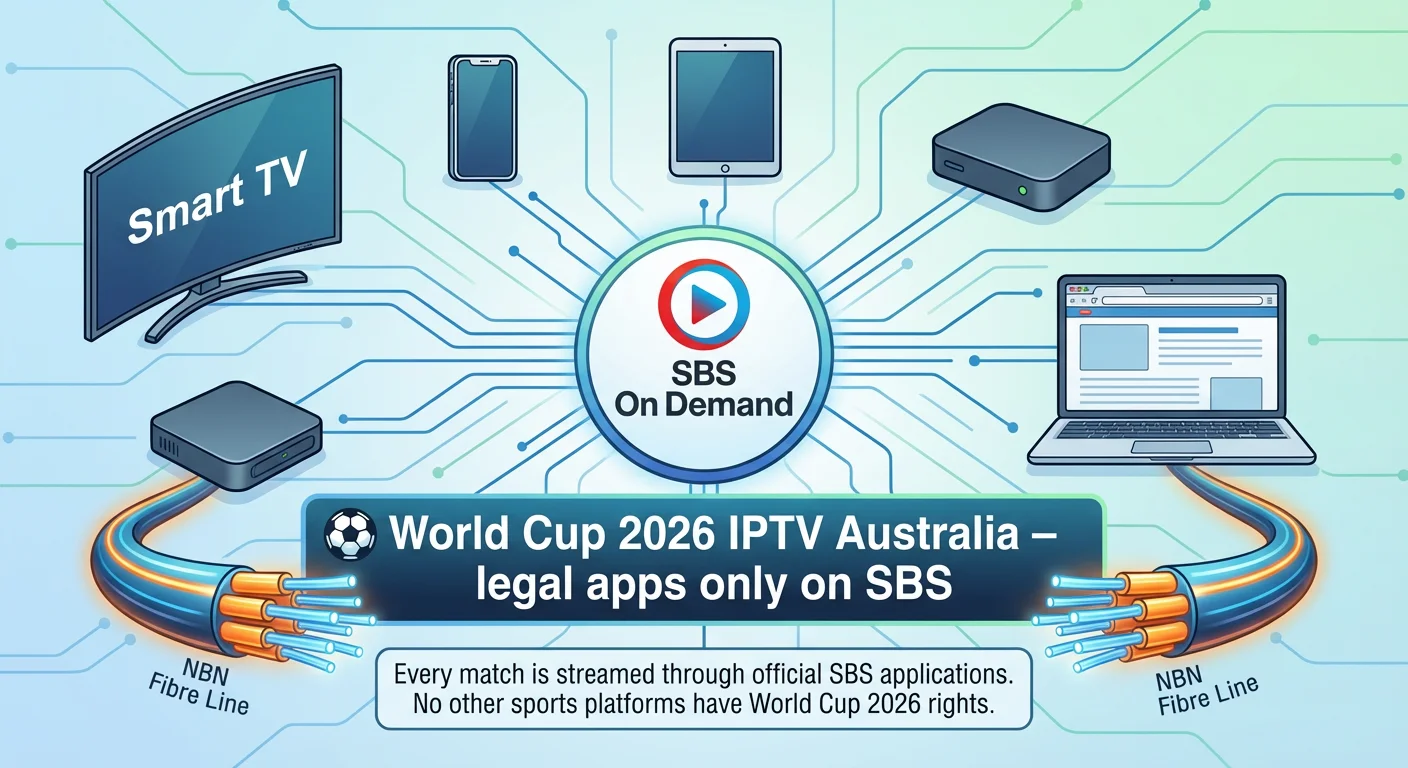
SBS provides the only confirmed legal World Cup 2026 IPTV Australia option, offering free access to all 104 tournament matches. This official coverage includes live streaming, replays, highlights, and comprehensive studio analysis.
SBS On Demand – Official Free IPTV Platform
SBS On Demand is Australia’s official free IPTV platform for World Cup 2026, available through dedicated apps on Smart TVs, mobile devices, tablets, streaming devices, and web browsers. The service requires a free account created with an email address and Australian location verification.
SBS On Demand supports up to 1080p HD streaming on capable devices and internet connections. The platform handles high traffic volumes during major sporting events, though some viewers experienced occasional buffering during peak 2022 World Cup viewing periods.
Access SBS On Demand through apps available on Samsung, LG, Sony, and Hisense Smart TVs, Apple TV, Google Chromecast, Telstra TV, Fetch TV, PlayStation, Xbox, and iOS/Android mobile devices. The platform also works through standard web browsers on computers.
All World Cup 2026 matches will be available live and as replays through SBS On Demand. The service includes multi-language commentary options, accessible closed captions, and comprehensive pre-match and post-match coverage.
Other Sports IPTV Platforms in Australia
Stan Sport, Kayo Sports, Paramount+, and Foxtel are popular Australian sports IPTV platforms offering various football and sports content. However, none of these services currently hold FIFA World Cup 2026 broadcasting rights in Australia.
Stan Sport covers domestic A-League football and some international competitions. Kayo Sports provides extensive sports coverage including rugby, cricket, and motorsports. Paramount+ offers UEFA Champions League and other European football. These platforms complement SBS for year-round football viewing but will not broadcast World Cup 2026 matches.
Note: Optus Sport, which previously held football broadcasting rights, ceased operations in 2024 with its content transferred to Nine Entertainment/Stan. Any references to Optus Sport for World Cup 2026 are outdated and incorrect.
World Cup 2026 Match Times for Australian IPTV Viewers
Understanding Australian time zones is crucial for planning World Cup 2026 IPTV viewing. The tournament’s North American location creates significant time differences affecting when Australians can watch matches.
Australian Time Zones Explained
AEST (Australian Eastern Standard Time) applies to Sydney, Melbourne, Brisbane, Canberra, and Tasmania during the World Cup 2026 period (June–July), as daylight saving is not in effect in these states.
ACST (Australian Central Standard Time) covers Adelaide and Darwin, running 30 minutes behind AEST. AWST (Australian Western Standard Time) applies to Perth and Western Australia, running 2 hours behind AEST.
Expected Match Times in Australian Time Zones
North American daytime matches (12pm-3pm local time) translate to approximately 2am-8am AEST the following day. These early morning kickoffs will challenge Australian viewers wanting to watch live.
Evening matches in North America (7pm-10pm local) occur between 10am-3pm AEST, which is more convenient for Australian audiences. However, exact times depend on specific host cities across the USA, Canada, and Mexico.
Western Australian viewers on AWST will find some matches more accessible. A 7pm kickoff on the US West Coast translates to 10am AWST next day, compared to noon AEST in eastern states.
SBS will provide comprehensive match schedules converted to all Australian time zones well before the tournament. Viewers unable to watch overnight matches live can use SBS On Demand replays available shortly after each match concludes.
NBN Requirements for World Cup 2026 IPTV Australia Streaming
Reliable World Cup 2026 IPTV streaming requires adequate NBN speeds and stable connections. Understanding your NBN plan and connection type helps ensure quality viewing during the tournament.
Internet Speed Requirements for IPTV Streaming
For stable 4K streaming through SBS On Demand or other IPTV platforms, maintain sustained download speeds of 25-35 Mbps with minimal fluctuation. HD quality requires 8-15 Mbps sustained speeds, while SD content works with 3-5 Mbps.
These are continuous speeds during active streaming, not the theoretical maximum speeds advertised for your NBN plan. Real-world performance often differs from advertised speeds, particularly during evening peak hours when network congestion increases.
NBN Plan Tiers and IPTV Performance
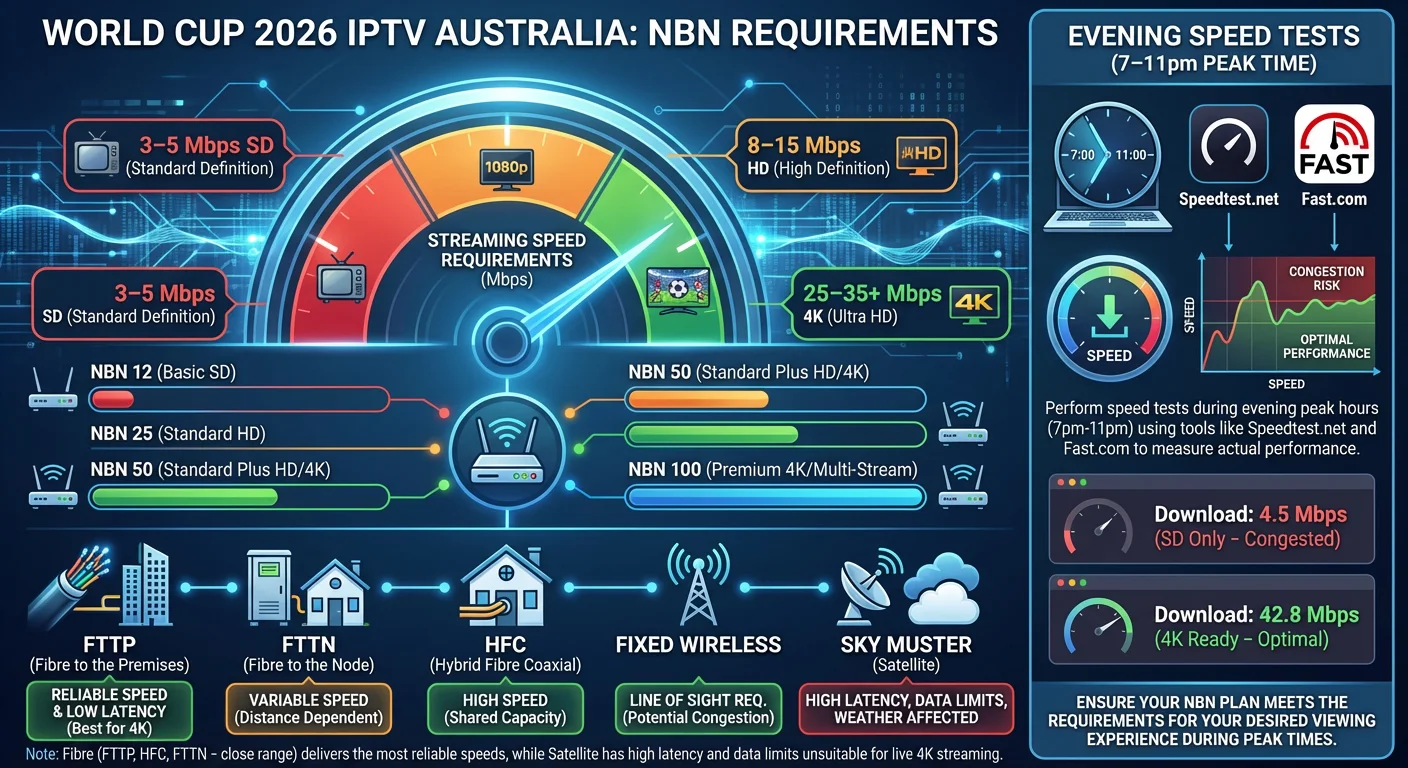
NBN 12 plans (12 Mbps maximum) are generally insufficient for quality HD streaming during peak hours. This tier struggles with consistent delivery even for SD streams when household bandwidth is shared.
NBN 25 plans (25 Mbps) handle HD streaming adequately for single-device viewing but struggle with 4K or multiple simultaneous streams. This tier is borderline for serious sports fans wanting optimal quality.
NBN 50 plans (50 Mbps) provide the recommended baseline for reliable 4K streaming on one primary device. This tier handles HD streaming on additional devices simultaneously without significant quality loss.
NBN 100 plans (100 Mbps) and above offer excellent performance for households with multiple devices streaming World Cup matches simultaneously. These higher tiers provide headroom for other internet activities during matches.
NBN Connection Types and Streaming Reliability
NBN FTTP (Fibre to the Premises) provides the most consistent IPTV streaming performance with minimal speed fluctuation during peak hours. This connection type delivers advertised speeds reliably.
NBN FTTN (Fibre to the Node) and HFC (Hybrid Fibre Coaxial) can support quality streaming but may experience more variability during evening peak usage. Performance depends on distance from the node and local network congestion.
NBN Fixed Wireless typically handles HD streaming adequately in regional areas but may experience congestion during peak hours. Evening performance testing is essential for Fixed Wireless users planning 4K viewing.
NBN Sky Muster satellite has inherent limitations for IPTV streaming. High latency (600+ ms) and data caps make 4K streaming impractical. Satellite users should prioritize HD or SD quality and carefully manage data allowances.
Testing Your NBN for IPTV Streaming
Run speed tests during evening hours (7pm-11pm) when NBN congestion peaks. This reveals actual available bandwidth during World Cup match times rather than off-peak optimistic results.
Use multiple speed test services (Speedtest.net, Fast.com, NBN Co speed test) to get accurate measurements. Run tests several times and note the consistency of results rather than just peak speeds.
Test your actual IPTV streaming performance during live sports events at the times you plan to watch World Cup matches. Stream existing football matches or other live sports through SBS On Demand to identify real-world issues.
Optimizing Your Home Network for IPTV Streaming
Proper home network configuration maximizes best IPTV for World Cup 2026 in Australia performance regardless of your NBN speed tier. Router placement, Wi-Fi setup, and bandwidth management significantly impact streaming quality.
Router Placement and Wi-Fi Configuration
Position your NBN router centrally with minimal physical barriers between the router and your primary streaming device. Australian brick construction and multiple-story homes often require Wi-Fi mesh systems or range extenders for reliable coverage.
Use 5GHz Wi-Fi bands for streaming devices whenever possible. The 5GHz frequency offers better performance for IPTV streaming despite shorter range compared to 2.4GHz, which experiences more interference from neighboring networks.
Consider upgrading from ISP-provided basic routers to higher-quality models with better Wi-Fi coverage and QoS (Quality of Service) features. Premium routers provide more consistent performance for IPTV streaming during peak household internet usage.
Ethernet vs. Wi-Fi for IPTV Streaming
Connect your primary streaming device via Ethernet cable whenever practical. Wired connections eliminate Wi-Fi variability and provide the most stable platform for 4K IPTV streaming.
If Ethernet isn’t feasible, position streaming devices within optimal Wi-Fi range. Use powerline adapters or Wi-Fi mesh systems to extend reliable connectivity to distant rooms in larger Australian homes.
Managing Household Bandwidth During Matches
Reduce network congestion during critical World Cup matches by temporarily pausing automatic cloud backups, software updates, and large downloads. These background activities consume bandwidth that could affect IPTV streaming quality.
Configure router QoS settings to prioritize streaming device traffic over other network activities. This ensures your World Cup IPTV stream receives available bandwidth first when multiple devices compete for internet resources.
Coordinate household internet usage during important matches. Ask family members to avoid starting bandwidth-intensive activities like 4K video uploads or large game downloads during live matches.
Compatible Devices for World Cup 2026 IPTV Australia
SBS On Demand and other IPTV platforms support various devices common in Australian households. Device capability and age significantly impact streaming quality and performance.
Smart TV IPTV Apps

Modern Smart TVs from Samsung, LG, Sony, and Hisense include built-in SBS On Demand apps providing direct access to World Cup 2026 streaming. Install apps from your TV’s app store and ensure firmware is updated before the tournament.
Smart TV apps typically provide the best IPTV viewing experience for large-screen watching. Newer models with 4K capability and hardware video decoding offer superior performance compared to older TVs requiring software processing.
Telstra TV, Fetch TV, and Other Streaming Devices
Telstra TV (provided with many Telstra NBN plans) and Fetch TV (common with Optus NBN) are popular Australian streaming devices supporting SBS On Demand and other IPTV platforms. Both integrate well with local NBN infrastructure.
Apple TV, Google Chromecast with Google TV, and similar devices offer excellent IPTV streaming capabilities. These premium devices handle 4K content reliably when paired with adequate NBN connections.
Gaming consoles including PlayStation and Xbox support SBS On Demand apps and provide reliable IPTV streaming platforms. Their powerful processors handle high-quality video decoding efficiently.
Mobile and Tablet IPTV Streaming
SBS On Demand mobile apps for iOS and Android enable on-the-go World Cup viewing. Mobile streaming automatically adjusts to lower resolutions to conserve cellular data and battery life.
For best mobile IPTV experience, connect to Wi-Fi when possible. Streaming 90-minute matches over cellular networks consumes significant data. Be aware of mobile plan limits to avoid excess data charges.
Regional and Rural Australia IPTV Streaming Considerations
Regional and rural Australian viewers face additional challenges for World Cup 2026 IPTV streaming beyond metropolitan areas. NBN availability and service quality vary significantly across regional locations.
NBN Fixed Wireless IPTV Performance
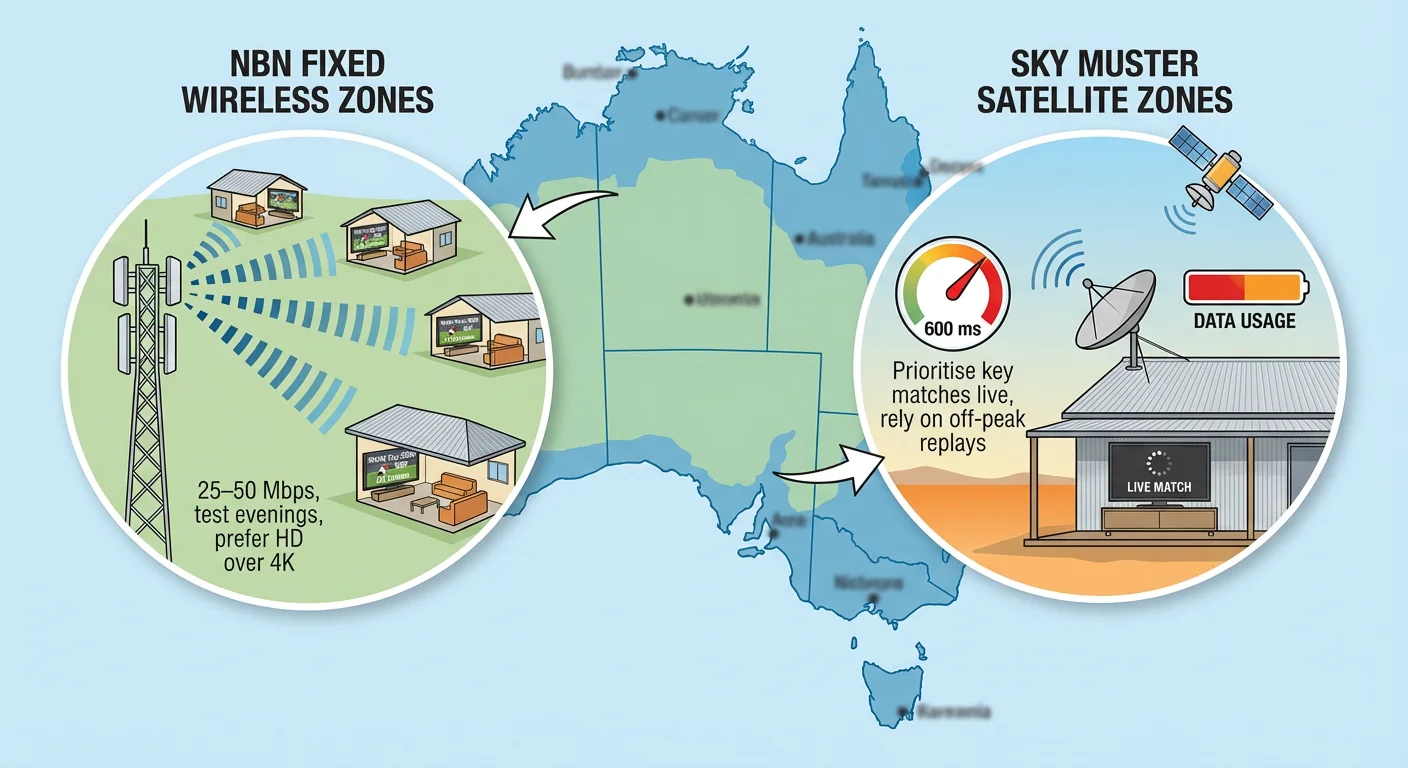
NBN Fixed Wireless in regional areas typically provides 25-50 Mbps speeds adequate for HD IPTV streaming. However, evening peak hour congestion may reduce available bandwidth when most viewers want to watch matches.
Test Fixed Wireless performance extensively before the tournament during evening hours. Consider adjusting streaming quality to HD rather than 4K if tests reveal inconsistent performance during peak periods.
Sky Muster Satellite IPTV Limitations
Sky Muster satellite users face significant IPTV streaming challenges. High latency (600+ ms) creates noticeable delays, and data caps make sustained 4K streaming impractical throughout a 90-minute match.
Sky Muster users should prioritize the most important matches for live HD viewing and rely on off-peak replays for other games. Download match replays overnight when data usage doesn’t count toward peak allowances.
Consider alternative viewing options for critical matches: watch at friends’ houses with better connectivity, visit local pubs or clubs, or attend community viewing events organized for major matches.
VPN Use with World Cup 2026 IPTV Australia
VPNs (Virtual Private Networks) are generally unnecessary for Australian viewers accessing SBS On Demand and other legal IPTV platforms. Understanding VPN implications helps avoid performance degradation.
Why VPNs Are Unnecessary for SBS Streaming
SBS On Demand is freely accessible throughout Australia without geographic restrictions within the country. Australian viewers with Australian IP addresses can access all World Cup 2026 content directly without VPN services.
Using VPNs for legal IPTV streaming in Australia may violate broadcaster terms of service and provides no benefit for domestic viewing. SBS specifically designs its IPTV infrastructure for Australian network conditions.
How VPNs Degrade IPTV Streaming Performance
VPNs add encryption overhead and routing complexity that typically increases latency by 10-30ms and reduces available bandwidth by 15-35%. This degradation is particularly problematic for live sports IPTV streaming during peak World Cup traffic.
Australian geographic isolation means VPN connections to international servers add substantial latency. Routing through distant servers can increase total latency by 50-200ms, causing noticeable stream delays and quality reduction.
VPN servers themselves often become overloaded during major sporting events. This creates additional bottlenecks beyond the VPN’s normal performance impact, further degrading IPTV streaming quality.
Legal Compliance Notice: Viewers should use only official licensed IPTV platforms and respect broadcaster terms of service. Using VPNs to circumvent geographic restrictions or access unlicensed streams may violate Australian telecommunications regulations and broadcaster agreements.
Testing Your Complete IPTV Setup Before World Cup 2026
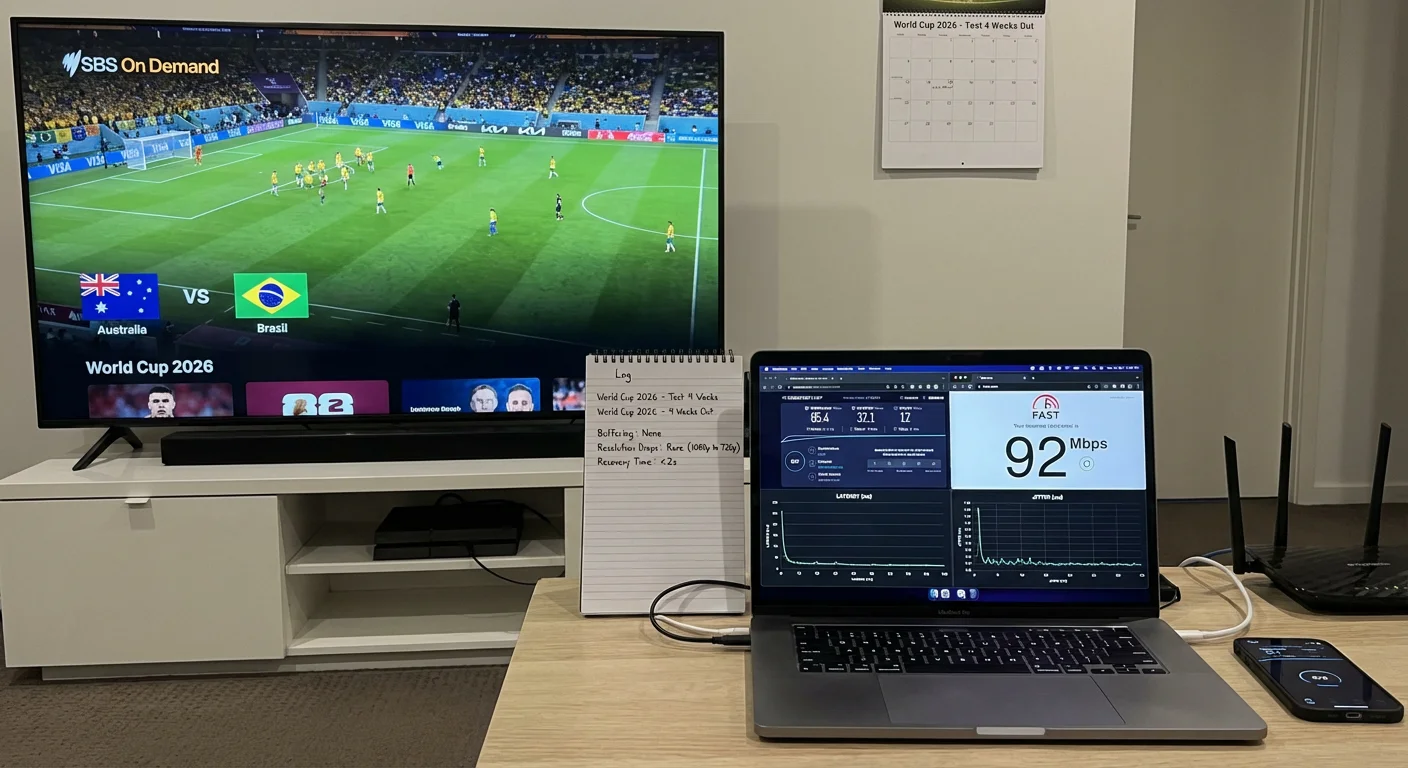
Comprehensive testing 2-4 weeks before the tournament identifies technical issues while time remains to resolve them. Testing during actual live sports events reveals problems that won’t appear during casual viewing.
Testing Schedule and Methodology
Watch complete 90-minute live matches using SBS On Demand during the times you plan to watch World Cup games. For early morning matches (2am-8am), test during these exact hours using overnight sporting events.
Document test results including connection stability, quality consistency, buffering frequency, and stream recovery time. Note whether issues occur at specific times (suggesting NBN congestion) or consistently (indicating setup problems).
Pay attention to the first 20 minutes after kickoff when IPTV server load increases dramatically. Many streaming issues only manifest during high-traffic periods, not during off-peak casual viewing.
Troubleshooting IPTV Streaming Issues
If testing reveals persistent problems, troubleshoot systematically. Verify NBN speeds during problem times using multiple test services. Test with wired Ethernet connection to eliminate Wi-Fi variables.
Try different devices to identify device-specific problems versus network-wide issues. Contact your ISP if speed tests consistently show below-plan performance during peak hours.
Early testing provides time to upgrade NBN plans, change ISPs, purchase better equipment, or explore alternative viewing arrangements before World Cup 2026 begins.
Legal IPTV Streaming for World Cup 2026 Australia
Using official licensed IPTV platforms protects viewers legally while supporting legitimate sports broadcasting. Understanding the difference between legal and illegal IPTV services helps Australian viewers make informed decisions.
Official vs. Unlicensed IPTV Services
Official IPTV services like SBS On Demand hold proper FIFA broadcasting rights negotiated through legitimate agreements. These platforms invest in infrastructure, pay rights fees, and operate within Australian telecommunications regulations.
Unlicensed IPTV services restream content without authorization, violating copyright laws and broadcaster agreements. These illegal services offer no quality guarantees, provide no viewer protections, and may expose users to legal risks.
Rights fees paid by official IPTV broadcasters fund tournament organization, team development, and global football infrastructure. Using authorized platforms ensures viewers contribute to the sport ecosystem while receiving reliable, high-quality streams.
How to Identify Legitimate IPTV Services
Official World Cup IPTV platforms prominently display FIFA licensing information, provide transparent terms of service, offer clear pricing (or free access like SBS), and maintain accessible customer support.
Avoid services making unrealistic claims about unlimited access without clear licensing information. Legitimate IPTV broadcasters provide detailed coverage information including specific match availability and quality options.
Verify broadcaster legitimacy through FIFA’s official website, which maintains updated lists of authorized rights holders by country. For Australia, SBS is the confirmed official World Cup 2026 broadcaster.
World Cup 2026 IPTV Australia – Frequently Asked Questions
What is IPTV and how does it work for World Cup 2026 in Australia?
IPTV (Internet Protocol Television) delivers video content through internet connections rather than traditional broadcast methods. For World Cup 2026, Australian viewers stream matches through SBS On Demand and other apps using their NBN or internet service. IPTV requires adequate bandwidth (25+ Mbps for 4K), compatible devices, and stable connections for quality viewing.
What NBN speed do I need for World Cup IPTV streaming?
For reliable 4K IPTV streaming, you need NBN 50 (50 Mbps) or higher with sustained speeds of 25-35 Mbps. NBN 25 handles HD streaming but may struggle with 4K. NBN 12 is generally insufficient for quality streaming during peak hours. Test your actual speeds during evening hours (7-11pm) to verify performance during match times.
Do I need a VPN for World Cup 2026 IPTV Australia streaming?
No, VPNs are unnecessary for Australian viewers accessing SBS On Demand and other legal IPTV platforms within Australia. VPNs add latency and reduce bandwidth, degrading streaming quality. SBS is freely accessible throughout Australia without geographic restrictions. Using VPNs may violate broadcaster terms of service and provides no benefit for domestic legal streaming.
What devices support World Cup 2026 IPTV streaming in Australia?
SBS On Demand supports Smart TVs (Samsung, LG, Sony, Hisense), streaming devices (Telstra TV, Fetch TV, Apple TV, Chromecast), gaming consoles (PlayStation, Xbox), and mobile devices (iOS, Android). Most modern Australian household devices support IPTV streaming. Ensure firmware and apps are updated before the tournament for optimal performance.
What time will World Cup 2026 matches be in Australia?
Most matches will occur during early morning (2am-8am AEST) or midday-afternoon (10am-3pm AEST) depending on North American kickoff times. Western Australian viewers (AWST) will find some matches more accessible due to the 2-hour time difference. SBS will provide complete schedules in all Australian time zones before the tournament. Replays will be available through SBS On Demand shortly after matches conclude.
Conclusion: Preparing for World Cup 2026 IPTV Australia
Successfully experiencing World Cup 2026 IPTV Australia requires using official SBS streaming, ensuring adequate NBN speeds (NBN 50+ recommended), and optimizing your home network setup. Test your complete configuration during live sports events 2-4 weeks before the tournament to identify and resolve any technical issues.
Australian viewers face time zone challenges with many early morning matches, but comprehensive replays through SBS On Demand ensure you won’t miss any action. Focus on the controllable factors: verify your NBN plan meets streaming requirements, position your router optimally, use Ethernet connections where possible, and familiarize yourself with the SBS On Demand platform. Legal IPTV options through SBS provide reliable, high-quality access to all 104 World Cup 2026 matches without additional costs or risks associated with unlicensed services.