
Last updated: December 2025 – covering IPTV legality in Australia for 2025–2026.
Introduction
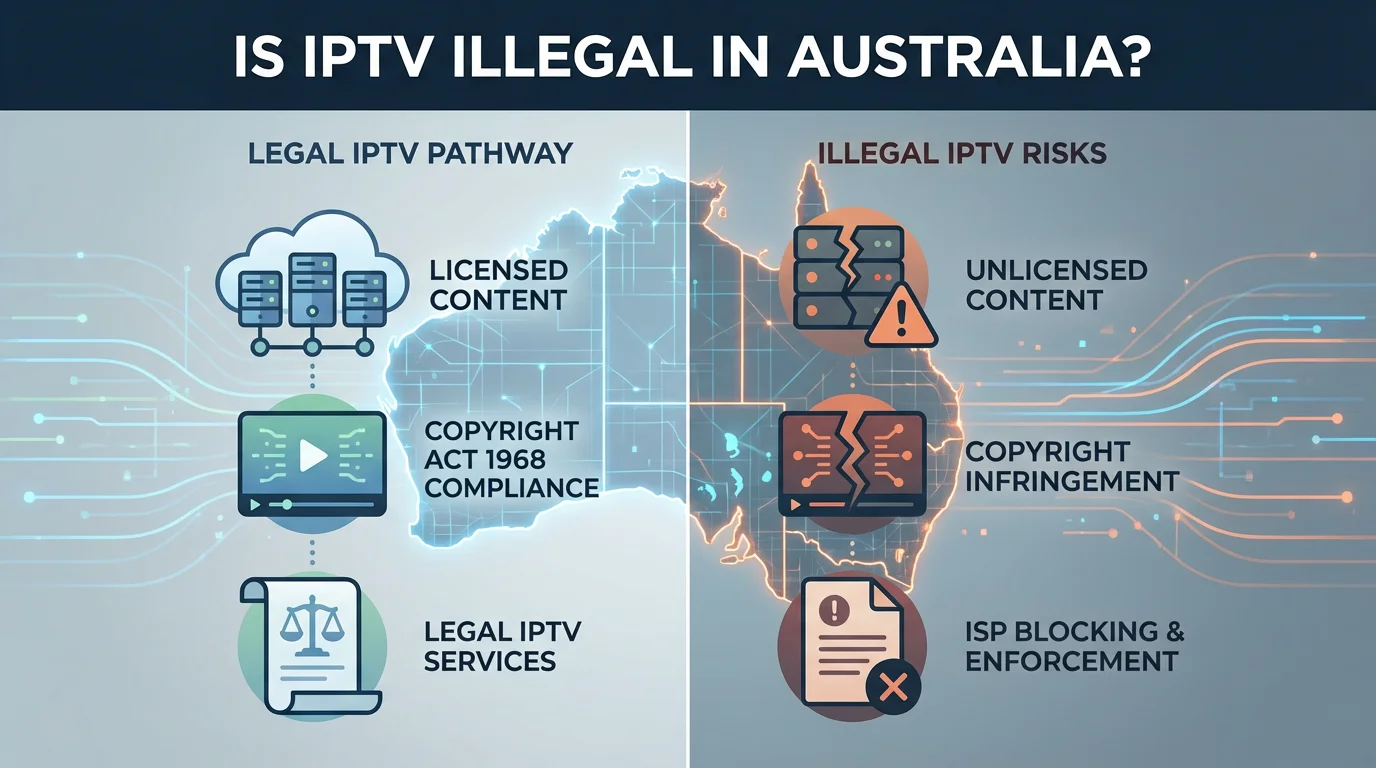
Many Australians wonder whether is IPTV illegal in Australia as they navigate an increasingly complex streaming landscape. Questions about IPTV legality in Australia arise from several factors: the proliferation of both licensed and unlicensed streaming platforms, ISP-level blocking of certain services, and high-profile copyright enforcement actions in Australian courts.
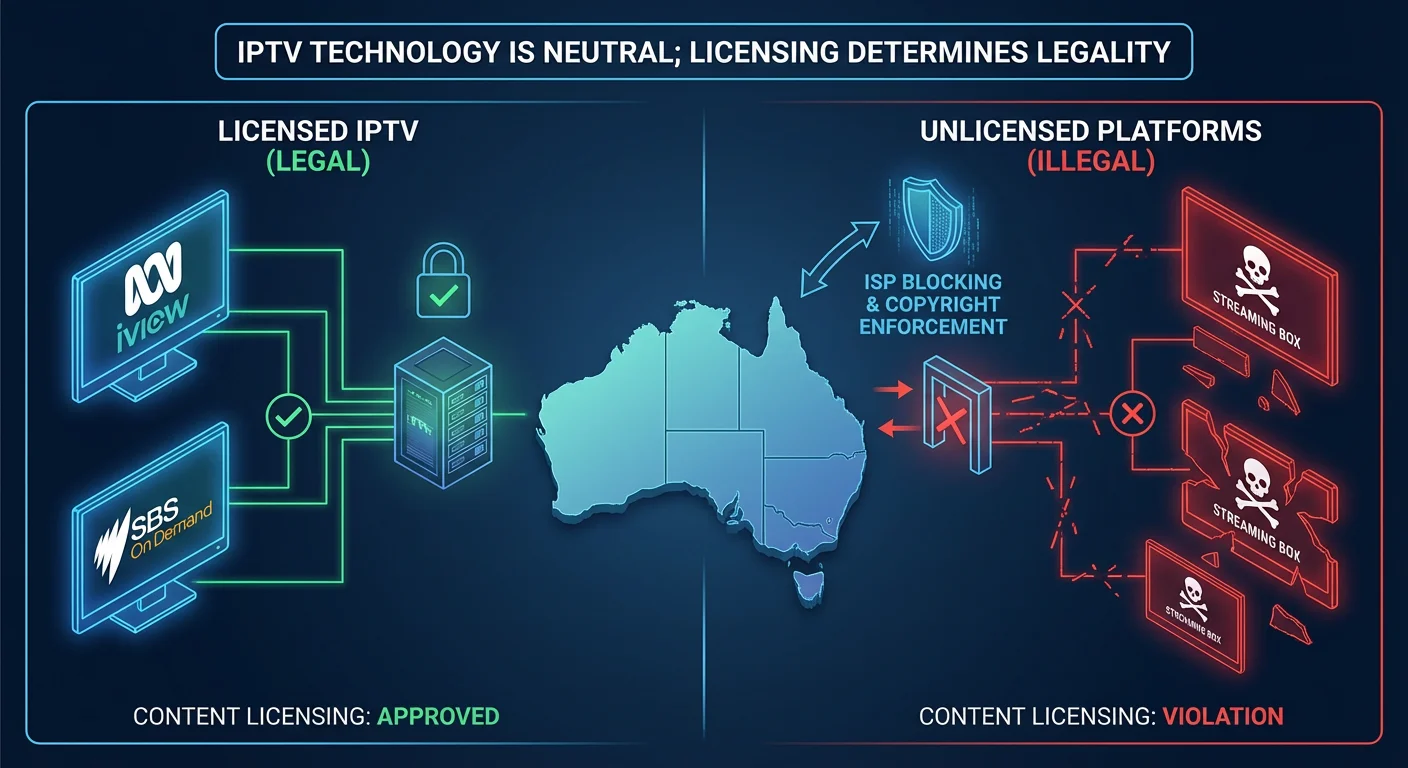
Internet Protocol Television (IPTV) itself is simply a technology for delivering video content over internet networks—the same technology used by legitimate services like ABC iview and SBS On Demand.
However, legality depends entirely on whether the service holds proper content licensing rights.
Disclaimer: This article provides legal information only and does not promote or endorse any IPTV service.
For specific legal advice, consult a qualified Australian legal professional.
Is IPTV illegal in Australia?
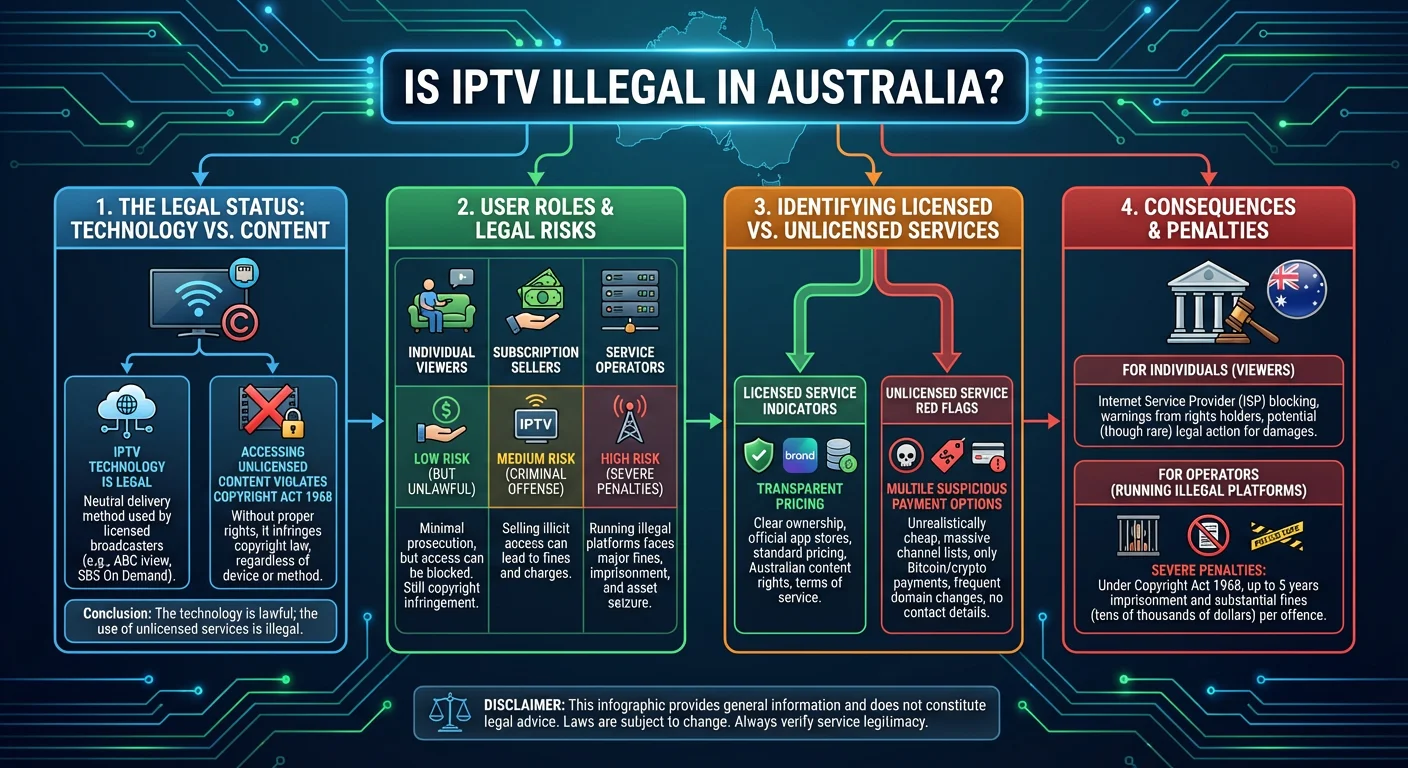
Direct Answer: IPTV is legal technology in Australia, but accessing unlicensed content is illegal. Specifically, accessing copyrighted content via unlicensed services violates the Copyright Act 1968 (Cth).
The technology itself is neutral—what matters is whether the content provider has obtained legal rights to distribute material in Australia.
In this video, you’ll learn if IPTV is illegal in Australia and how Australian copyright law regulates streaming services.
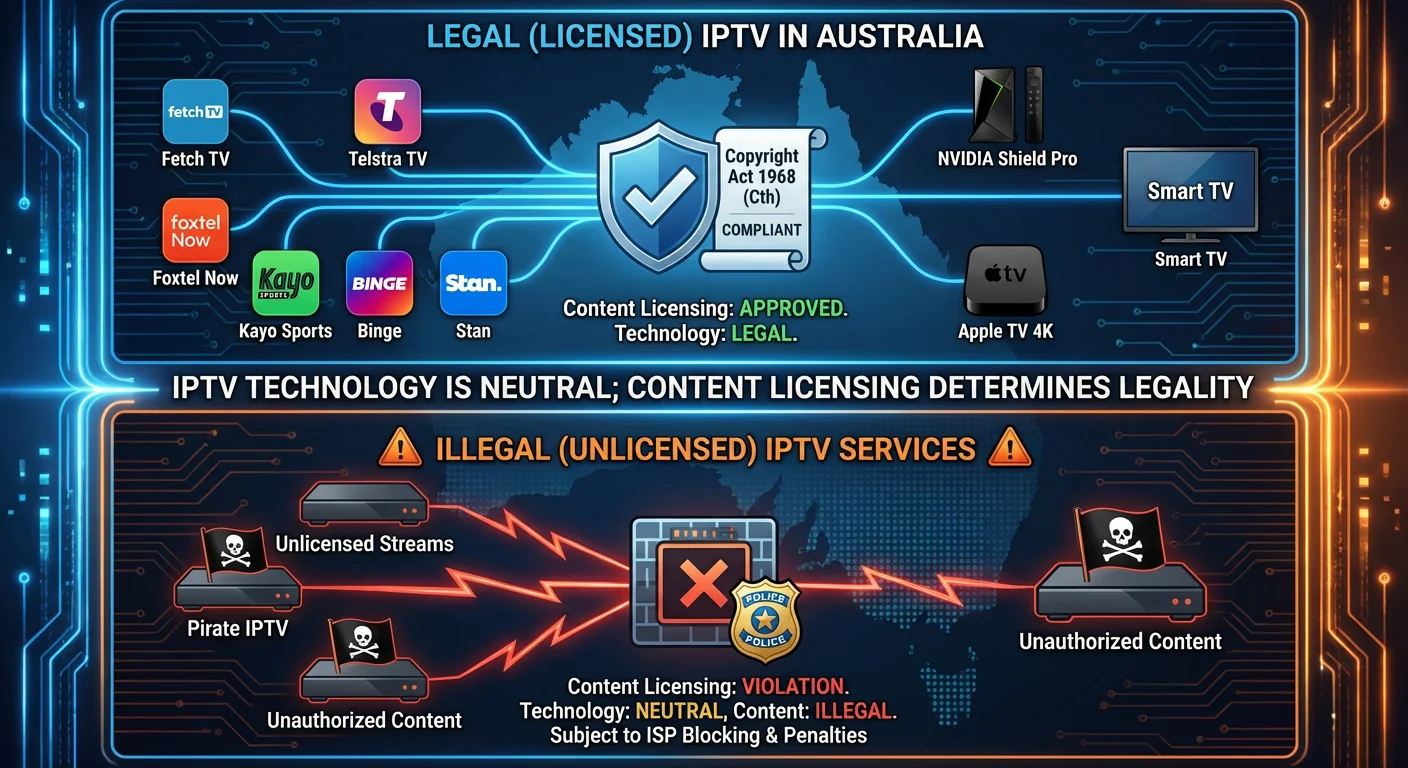
Many legitimate Australian broadcasters and streaming platforms use IPTV technology, including major telecommunications providers and public broadcasters.
Licensed services like Fetch TV, Telstra TV, and legal streaming platforms demonstrate how IPTV technology operates lawfully when proper content licensing exists.
These services typically run on approved devices like NVIDIA Shield, Apple TV, or dedicated set-top boxes from Telstra and Optus.
The legal issue arises when services distribute movies, television shows, or live sports without authorization from copyright holders.
What makes an IPTV service illegal under Australian law?
Direct Answer: A service becomes illegal when it distributes copyrighted content without authorization from rights holders. Understanding the legal status of IPTV services in Australia requires examining whether they comply with sections 86 and 101 of the Copyright Act 1968, which prohibit unauthorized communication of works to the public.
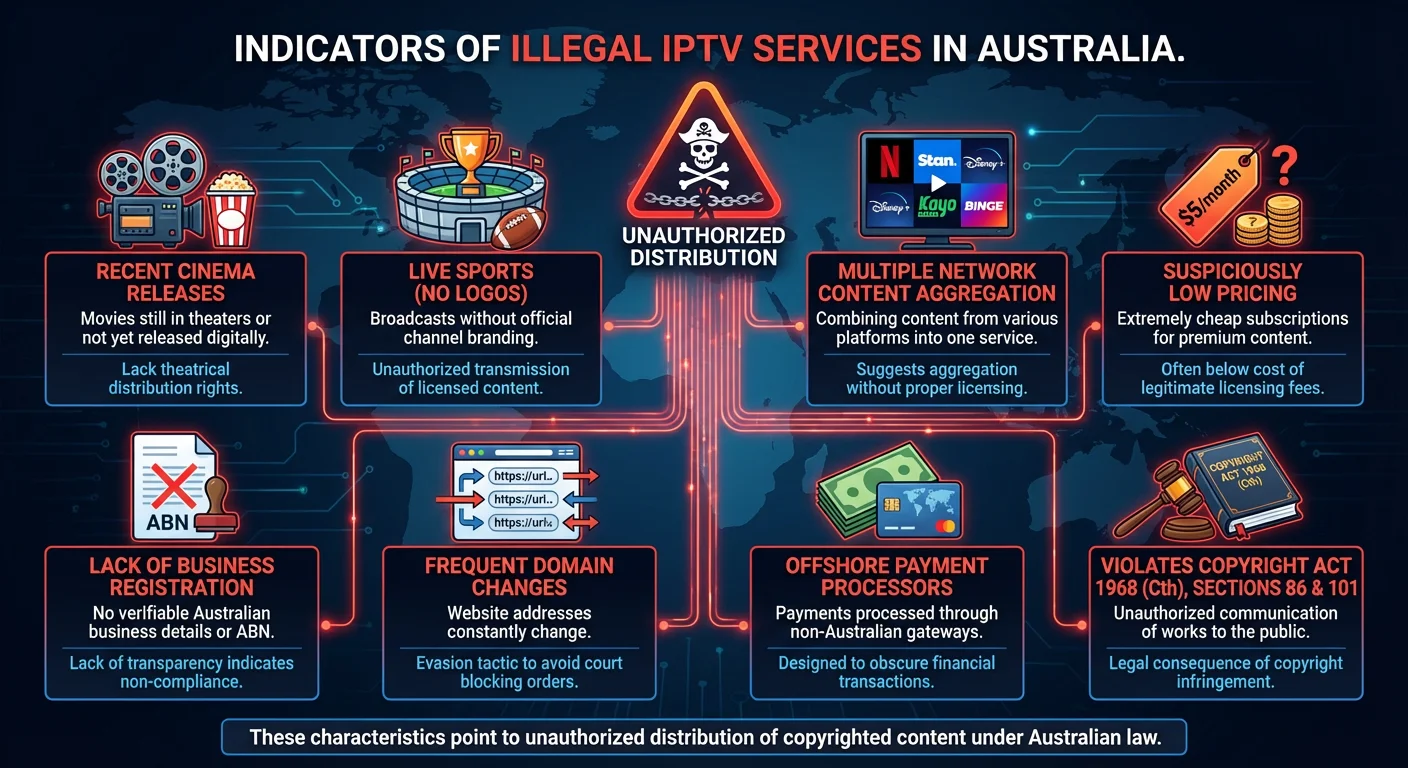
Legal red flags include:
| Warning Sign | Legal Implication |
|---|---|
| Recent cinema releases available | Indicates lack of theatrical distribution rights |
| Live sports without broadcaster logo | Unauthorized transmission of licensed content |
| Multiple network content in one place | Suggests aggregation without proper licensing |
| Suspiciously low pricing | Often below cost of legitimate licensing fees |
| No business registration details | Lack of transparency indicates non-compliance |
| Frequent domain changes | Evasion tactic to avoid court blocking orders |
| Offshore payment processors | Designed to obscure financial transactions |
These characteristics suggest a service lacks proper content licensing, regardless of how the technology delivers content to users.
Is watching IPTV treated differently from selling or distributing it?
Direct Answer: Australian copyright enforcement primarily targets operators, distributors, and sellers of unlicensed services rather than individual viewers.
However, accessing unlicensed content still constitutes copyright infringement under Australian law, even if prosecution of individual consumers remains rare.
| User Type | Legal Status | Enforcement Risk |
|---|---|---|
| Individual Viewer | Accessing unlicensed content is unlawful | Currently minimal prosecution risk |
| Subscription Seller | Facilitating copyright infringement | High risk – criminal prosecution possible |
| Service Operator | Commercial copyright violation | Very high risk – raids, arrests, asset seizure |
| Content Distributor | Unauthorized communication to public | Very high risk – civil and criminal liability |
The distinction matters for practical enforcement purposes.
Rights holders and law enforcement focus resources on disrupting the supply chain—those who profit from copyright infringement—rather than pursuing residential internet users.
The Australian Federal Police and copyright enforcement agencies have conducted raids on suppliers and seized equipment, but individual subscription holders currently face minimal direct legal action.
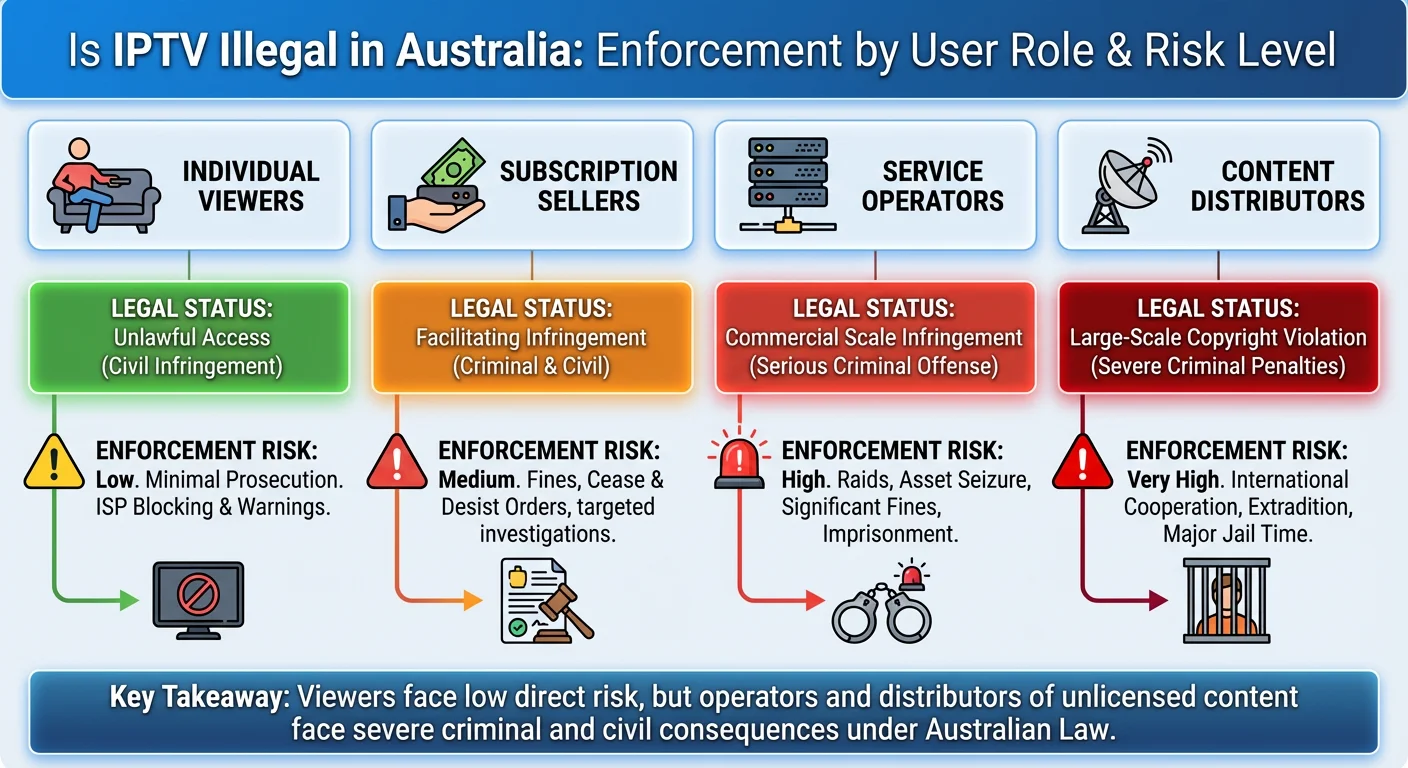
This enforcement pattern does not create legal immunity for viewers.
Accessing copyrighted content without authorization remains unlawful; enforcement priorities simply reflect resource allocation decisions by authorities and rights holders.
What role does ACMA actually play in IPTV regulation?
Direct Answer: The Australian Communications and Media Authority (ACMA) does not approve, license, or certify IPTV providers.
ACMA’s role involves regulating telecommunications infrastructure and broadcast licensing for traditional media, not assessing individual streaming services.
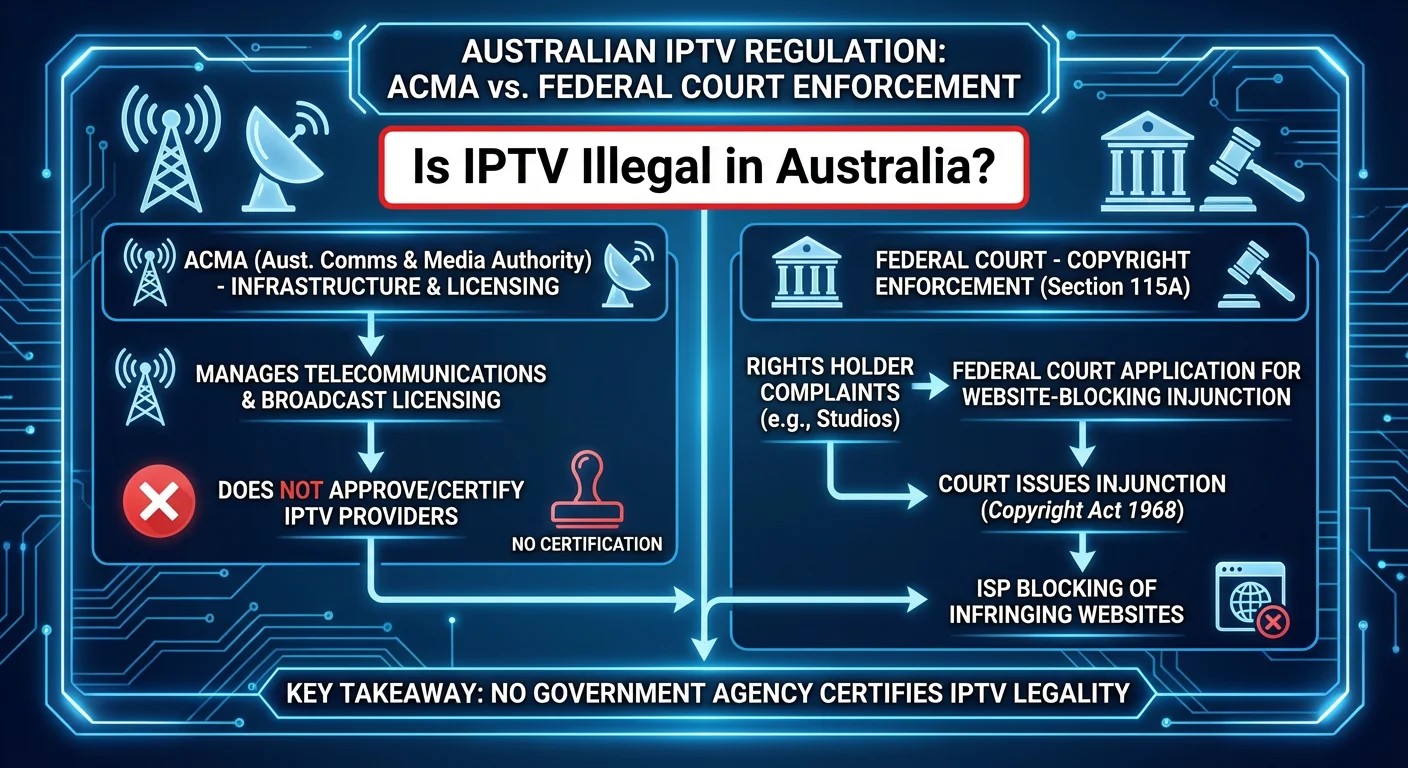
Copyright enforcement occurs through the Federal Court system.
Rights holders can apply for website-blocking injunctions under section 115A of the Copyright Act 1968.
When granted, these court orders require Australian ISPs to block access to specific domains identified as facilitating copyright infringement.
You can review actual court decisions and blocking orders through the Federal Court of Australia website.
ACMA does not issue these orders or maintain lists of approved services.
Claims about “ACMA-approved IPTV services” misrepresent the regulatory framework.
No Australian government agency provides certification that would indicate a service operates legally.
For authoritative information about communications regulation, visit ACMA’s official website. Consumers must independently verify whether a service holds legitimate licensing agreements.
Can Australian ISPs block IPTV services?
Direct Answer: Australian ISPs must comply with Federal Court blocking orders that target websites and services facilitating copyright infringement.
Since 2016, courts have issued numerous orders requiring ISPs to block access to unlicensed streaming platforms.
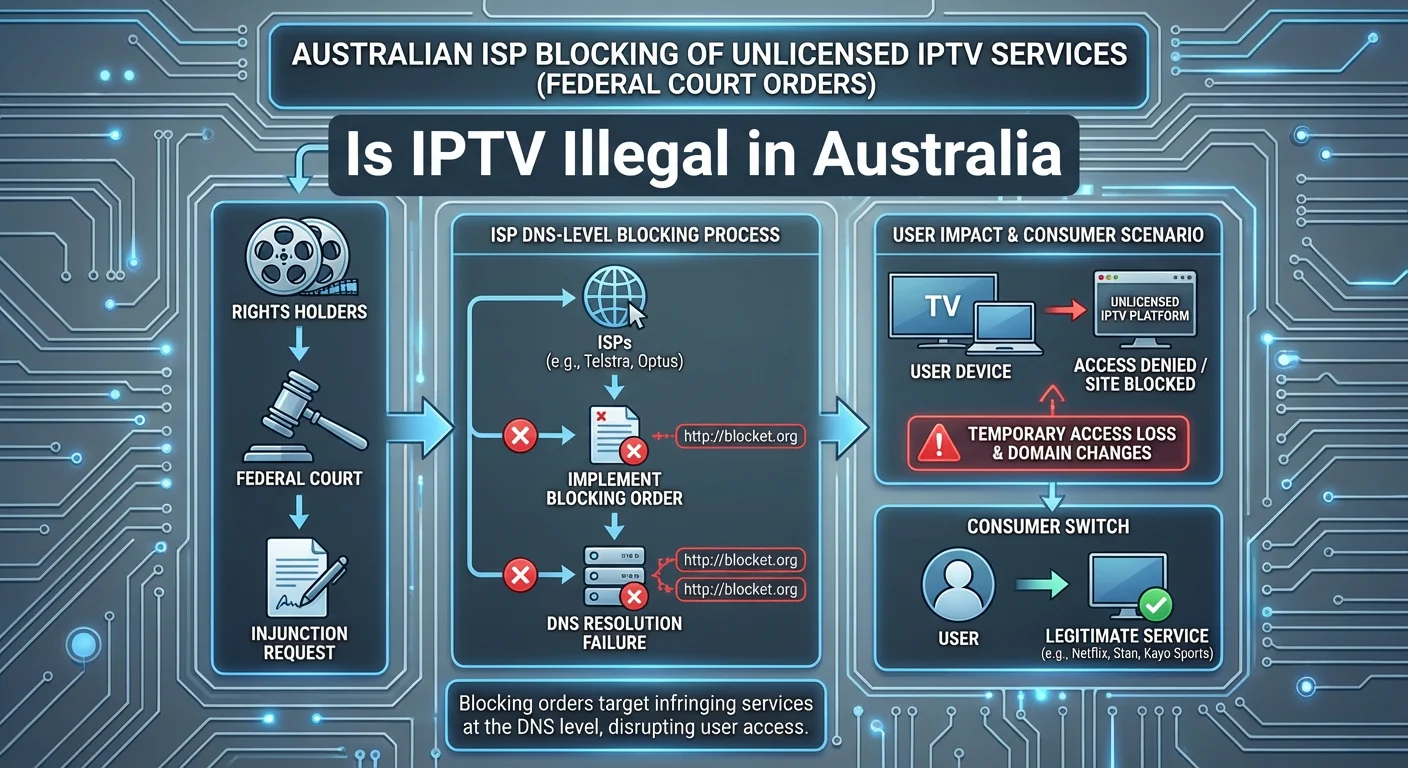
The blocking mechanism works at the DNS level, preventing Australian residential internet connections from resolving domain names listed in court orders.
Rights holders, including major film studios, television networks, and sports organizations, regularly apply to extend these orders to cover new domains and mirror sites.
Consumer scenario: Sarah, a Melbourne resident, subscribed to what appeared to be an affordable streaming service offering live sports and movies.
After three months, she found the platform suddenly inaccessible through her Telstra home internet connection following a Federal Court order.
The service reappeared under a different domain name days later, but required her to sign up again with a new payment method. This pattern—sudden blocking followed by domain changes—is typical of unlicensed services operating without proper licensing agreements.
Sarah eventually switched to a legitimate service like Kayo Sports, which costs more but operates reliably within Australian legal frameworks.
This blocking system focuses on disrupting access to identified infringing services rather than monitoring individual user behavior.
Does using a VPN change IPTV legality in Australia?
Direct Answer: Using a VPN does not change the underlying legality of accessing unlicensed content.
Copyright infringement remains unlawful regardless of technical methods used to access content.
VPNs may circumvent ISP blocking but do not provide legal authorization to access copyrighted material.
Australian copyright law applies to activities within Australian jurisdiction.
A VPN changes the technical routing of internet traffic but does not alter legal obligations under the Copyright Act 1968. Rights holders can pursue infringement claims based on the substantive act of accessing unauthorized content, independent of the technical mechanism used.
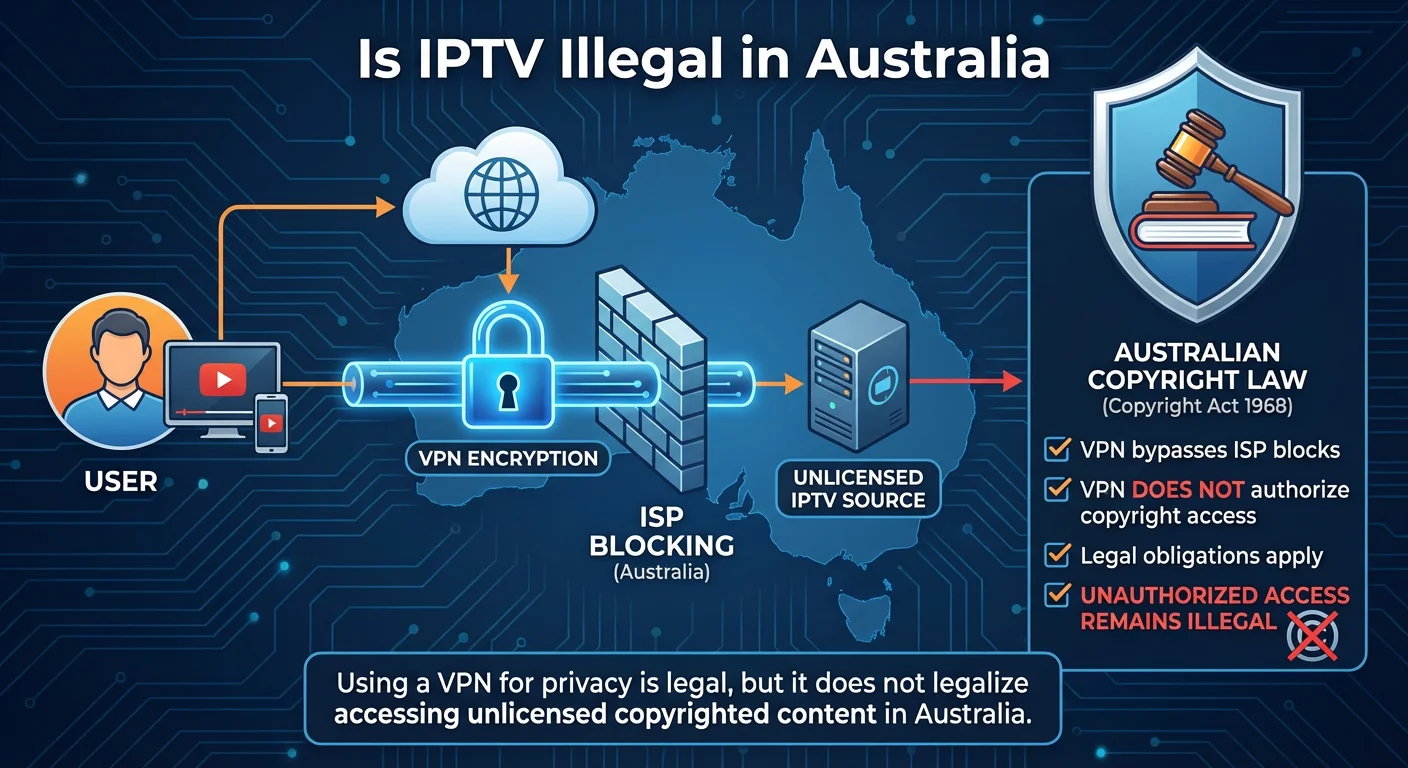
VPN services themselves operate lawfully in Australia and serve many legitimate purposes, including privacy protection and secure remote access.
However, using privacy tools does not transform unlawful copyright infringement into lawful activity.
For more guidance on legal streaming setup and compliance, consult resources specific to Australian regulations.
Frequently Asked Questions
Is IPTV illegal in Australia in 2026?
As of 2026, IPTV technology remains legal in Australia, but accessing copyrighted content through unlicensed services continues to violate the Copyright Act 1968. The legal framework has not changed—what matters is whether services hold proper licensing agreements.
Australian courts continue issuing blocking orders against unlicensed platforms, while enforcement focuses primarily on operators rather than individual viewers.
The technology itself is widely used by legitimate broadcasters and streaming platforms throughout Australia.
Is IPTV illegal in Australia if I only watch free content?
Whether content appears “free” to the viewer does not determine legality.
If the service distributes copyrighted material without proper licensing, accessing that content infringes copyright regardless of subscription costs.
Free services without licensing agreements often generate revenue through advertising or data collection while still violating copyright law.
How can I tell if an IPTV service is legal in Australia?
Legitimate services typically operate transparently with clear business registration, publicly available licensing information, and pricing comparable to other licensed platforms.
Our comprehensive Australian IPTV provider guide explains how to identify licensed services.
| Legal Service Indicators | Unlicensed Service Red Flags |
|---|---|
| Transparent company registration (ABN visible) | No business details or offshore registration |
| Clear licensing agreements disclosed | Vague or missing licensing information |
| Pricing comparable to industry standards | Unrealistically low subscription costs |
| Geo-restricted content libraries | Worldwide access to all content |
| Official payment methods (credit cards) | Cryptocurrency or gift cards only |
| Professional customer support | Limited or anonymous support channels |
| Stable domain and branding | Frequent URL changes or mirror sites |
If a service shows multiple red flags from the right column, it likely operates without proper licensing.
What happens if Australian authorities catch me using illegal IPTV?
Enforcement actions overwhelmingly target service operators rather than residential subscribers.
Individual users currently face minimal risk of prosecution, though accessing unlicensed content remains unlawful.
The primary consequence for users involves service disruptions when Federal Court blocking orders take effect, potentially rendering subscriptions worthless.
Are all subscription IPTV services illegal in Australia?
No. Many legitimate services use IPTV technology to deliver legal content in Australia.
Licensed platforms include Fetch TV (available through major retailers), Telstra TV (bundled with Telstra broadband), Optus Sport, Kayo Sports, Binge, Stan, and ABC iview. These services operate on various devices including smart TVs, Apple TV, Android TV boxes like NVIDIA Shield, Amazon Fire TV, and dedicated set-top boxes. As detailed in our legal IPTV streaming guide, the technology itself is standard for modern content delivery. Legality depends on licensing agreements, not the underlying technology or subscription model.
When choosing to watch IPTV legally in Australia, verify the provider holds proper content rights.
Can copyright holders see what I’m watching on IPTV services?
Rights holders cannot directly monitor individual viewing activity on third-party services.
Copyright enforcement typically relies on investigating service operators, analyzing publicly available service information, and obtaining court orders.
Individual viewing behavior remains private unless service operators share data or law enforcement obtains warrants during investigations of specific operations.
Does Australian law distinguish between IPTV and other streaming methods?
Australian copyright law applies uniformly regardless of delivery technology.
Whether content arrives through IPTV protocols, progressive download, adaptive streaming, or other technical methods makes no legal difference.
The relevant factor remains whether the service holds authorization to distribute specific copyrighted content.
Is it illegal to sell IPTV subscriptions in Australia?
Distributing or selling access to unlicensed copyrighted content clearly violates Australian copyright law and can result in criminal prosecution.
Individuals who profit from facilitating copyright infringement face significantly higher legal risk than residential viewers. Law enforcement has conducted searches and arrests of individuals selling subscriptions to unlicensed services.
What is the penalty for running an illegal IPTV service in Australia?
Under the Copyright Act 1968, commercial-scale copyright infringement can result in substantial fines and imprisonment.
The maximum penalty for individuals is five years imprisonment and significant financial penalties.
Companies face even larger fines. Courts can also order asset seizures and impose damages based on commercial harm to rights holders.
Additional Resources for Australian IPTV Users
If you found this guide helpful, these related articles provide deeper insights into IPTV streaming in Australia:
Legal & Compliance Guides:
- Legal IPTV Streaming In Australia: Expert Guide – Navigate copyright laws and choose legitimate streaming solutions safely
Technical Setup & Troubleshooting:
- IPTV Setup Guide Australia: 7 Easy Steps & Troubleshooting – Step-by-step device configuration for NBN connections with common problem fixes
- Best Kodi Add-ons And IPTV Legality In Australia Guide – Legal compliance information and safe streaming practices for Kodi users
These resources complement the sports-specific advice in this article and help you make informed decisions about IPTV subscriptions in Australia.
Conclusion
Understanding Australian IPTV laws helps consumers make informed streaming choices in 2026.
IPTV technology operates lawfully in Australia when services hold proper content licensing. Understanding whether IPTV is illegal in Australia helps Australians make informed streaming choices.
The answer is nuanced: the technology itself is legal, but accessing copyrighted content through unlicensed services violates Australian IPTV copyright laws.
While enforcement focuses primarily on operators and distributors, accessing unauthorized content remains unlawful for all users.
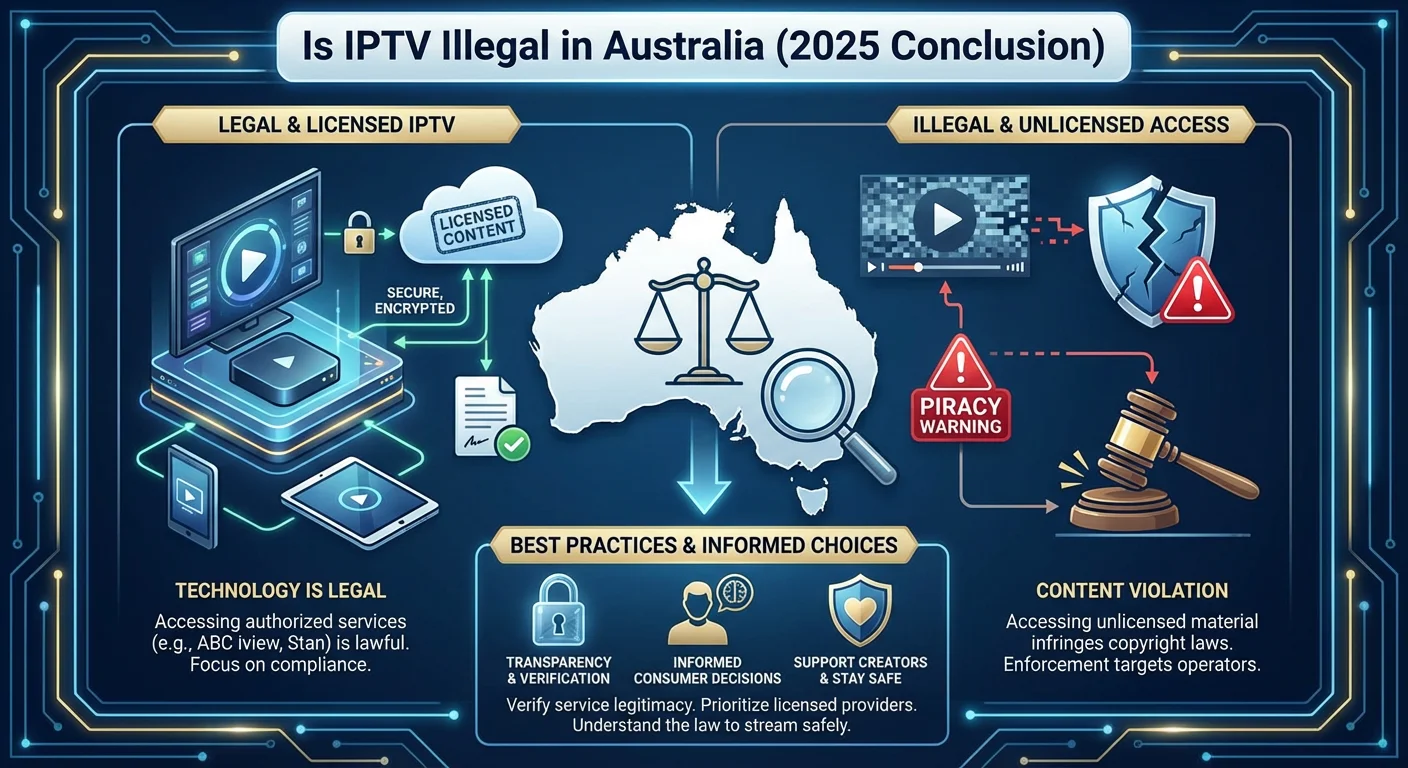
Australians seeking streaming services should verify that providers operate transparently with legitimate licensing agreements.
For detailed setup instructions and legal compliance guidance, visit our IPTV setup guide for Australia.
Confusion about whether you can watch IPTV legally in Australia often stems from the technical sophistication of modern streaming platforms, but Australian copyright law applies consistently regardless of delivery technology.
For official information about copyright enforcement and telecommunications regulation, consult Australian Copyright Council and ACMA.
Making informed, lawful choices protects both individual interests and the broader creative industries that produce the content Australians enjoy.
Author

Our Fact Checking Process
We prioritize accuracy and integrity in our content. Here's how we maintain high standards:
- Expert Review: All articles are reviewed by subject matter experts.
- Source Validation: Information is backed by credible, up-to-date sources.
- Transparency: We clearly cite references and disclose potential conflicts.
Our Review Board
Our content is carefully reviewed by experienced professionals to ensure accuracy and relevance.
- Qualified Experts: Each article is assessed by specialists with field-specific knowledge.
- Up-to-date Insights: We incorporate the latest research, trends, and standards.
- Commitment to Quality: Reviewers ensure clarity, correctness, and completeness.
Look for the expert-reviewed label to read content you can trust.